
Open-Source AI Document Processing for Banking: Building Secure, Private and Intelligent Document Workflows

Banks process thousands of documents every day, from customer identification records and KYC forms to financial statements, loan applications, contracts, and regulatory documentation.
Despite significant investment in digital transformation, many banking operations still depend on manual document classification, data extraction, verification, and transfer of information between systems.
Artificial Intelligence can help financial institutions automate these activities. However, adopting AI document processing often introduces new challenges related to data privacy, infrastructure control, technology dependencies, and implementation costs.
What if banks could start building their own AI-powered document processing solutions using a real open-source platform, rather than developing everything from scratch?
This is the opportunity offered by elDoc IDP OSS, an open-source Intelligent Document Processing (IDP) module developed by elDoc.
Available on GitHub, elDoc IDP OSS provides a foundation for building AI-powered document processing applications, combining OCR, document classification, structured data extraction, configurable Large Language Model (LLM) integration, and human-in-the-loop validation.
elDoc IDP OSS provides banks with a ready-to-use, open-source foundation for building intelligent document processing solutions.
Instead of developing AI document processing capabilities from scratch, financial institutions can leverage an existing platform that combines OCR, AI-powered document classification, structured data extraction, configurable LLM integration, and human-in-the-loop validation.
Banks can deploy, customize, and extend this foundation to address their specific document processing requirements, integrate with internal banking systems through custom development, and build tailored automation workflows while maintaining control over their technology architecture and infrastructure.
The objective is not simply to experiment with AI, but to establish a practical, extensible foundation for AI-powered document processing across banking operations.
1. Why Banks Need an Open-Source Foundation for Intelligent Document Processing
Banking is one of the most document-intensive industries.
Customer onboarding, credit assessments, trade finance, compliance, legal operations, and internal audits require employees to collect, review, interpret, and verify information across multiple documents.
These documents often arrive in different formats:
- Scanned PDFs and image-based records.
- Digital bank statements and financial reports.
- Customer identification and corporate registration documents.
- Contracts, agreements, and application forms.
- Multi-page documents containing tables and complex layouts.
- Historical archives with inconsistent document structures and image quality.
Traditional document processing systems often rely on predefined templates, fixed extraction rules, and manual verification.
Such approaches can become difficult to maintain when document layouts change, new document types are introduced, or information must be extracted from multiple sources.
AI-powered Intelligent Document Processing provides a more flexible approach.
By combining OCR, document understanding, and LLM-based extraction, banks can automate parts of the document processing lifecycle and transform unstructured information into structured data.
Why Open Source Matters for Banking
For banking technology teams, adopting an open-source foundation provides several important advantages.
| Advantage | Value for Banking Technology Teams |
|---|---|
| Technology Transparency | Inspect the source code, understand the platform architecture, and maintain visibility into how document processing components are implemented. |
| Greater Customization Flexibility | Adapt document processing logic, extraction configurations, and application functionality to specific banking requirements, subject to applicable licensing terms. |
| Reduced Development Effort | Build upon existing OCR, AI extraction, document classification, validation, and export capabilities instead of developing every component from scratch. |
| Flexibility in AI Model Selection | Integrate compatible AI providers or locally deployed models based on security, infrastructure, performance, and operational requirements. |
| Ownership of the Solution Architecture | Deploy, manage, and extend the open-source application within bank-controlled infrastructure and the existing technology environment. |
| Foundation for Banking-Specific Applications | Focus development resources on KYC, lending, financial document processing, and other banking workflows rather than rebuilding core IDP functionality. |
The strategic advantage: Banks can leverage an established open-source AI document processing foundation, reduce development complexity, and focus on building customized solutions aligned with their business, security, and operational requirements.
2. Introducing elDoc IDP OSS: An Open-Source AI Document Processing Platform
elDoc IDP OSS is the open-source edition of the Intelligent Document Processing (IDP) module, which forms part of the broader elDoc GenAI Enterprise Document Intelligence Platform.
It provides the essential capabilities required to convert documents into structured information through AI-assisted processing and human validation.
The platform brings together document ingestion, OCR, AI-powered classification, structured data extraction, human review, and data export within a single application.
How elDoc IDP OSS Works
The document processing lifecycle consists of five main stages.
Step 1 — Document Upload
Users upload documents such as PDFs, scanned records, and image files through the web interface.
Step 2 — OCR and Document Recognition
The platform processes documents using configured OCR or vision-language technologies to recognize text and prepare document content for AI interpretation.
Step 3 — AI Classification and Data Extraction
AI identifies document types and extracts relevant information according to the configured processing requirements.
Step 4 — Human Validation
Users review the extracted information and validate the results before further use.
Step 5 — Structured Data Export
Validated information can be exported in CSV format for use in downstream applications and business processes.
Unlike a standalone OCR engine or an isolated AI model, elDoc IDP OSS combines these components into a working Intelligent Document Processing application.
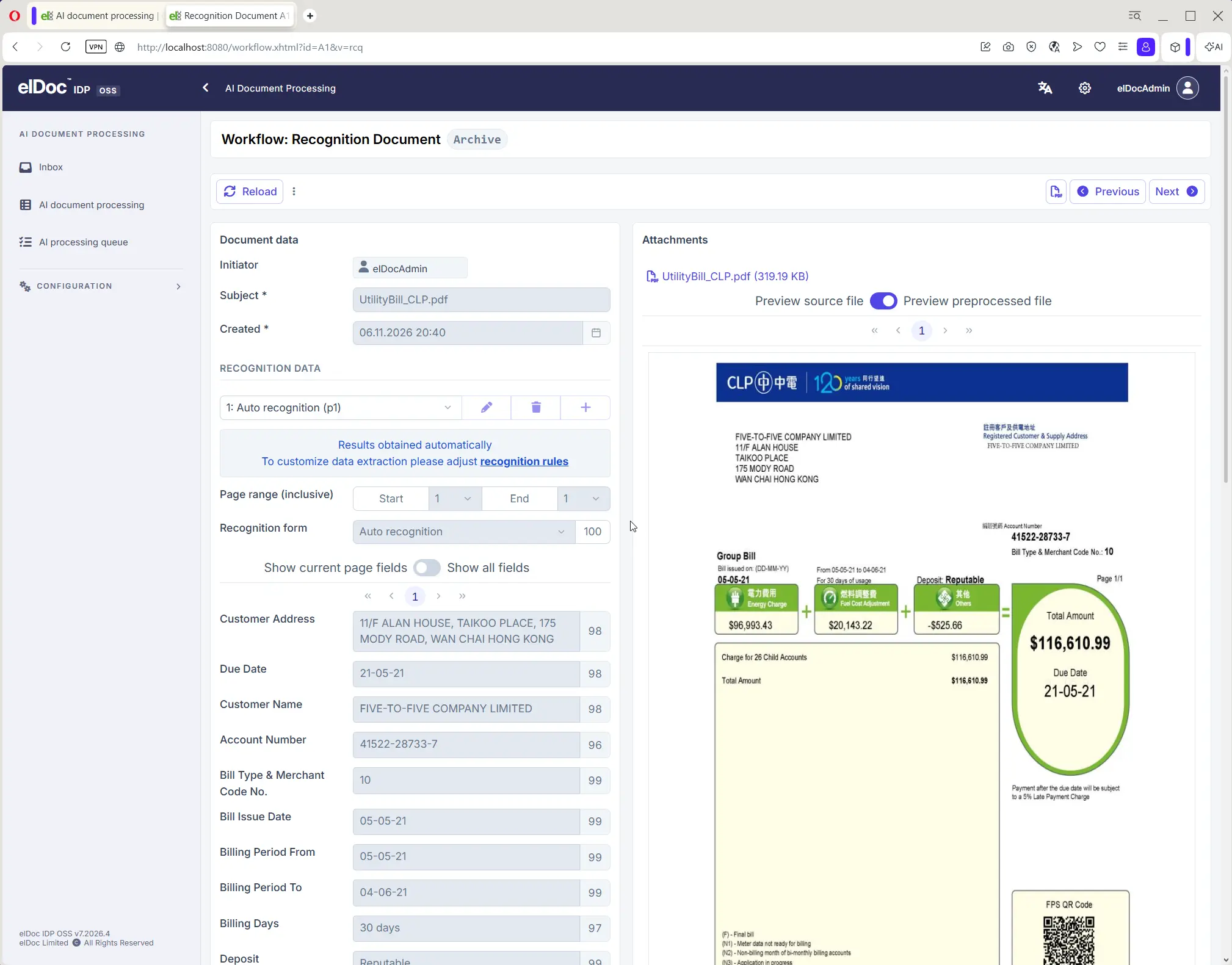
For banks, this provides a foundation for developing customized AI document processing solutions without building every component independently.
3. Core Capabilities of elDoc IDP OSS for Banking
OCR and Processing of Scanned Banking Documents
A significant amount of banking information remains stored in scanned documents, image-based PDFs, and historical archives.
These documents often contain valuable information that cannot be accessed directly through conventional database queries.
elDoc IDP OSS includes OCR and image processing capabilities to recognize text and prepare documents for AI analysis.
The platform supports processing of machine-generated PDFs, scanned PDFs, images, and multi-page TIFF documents.
Document preprocessing includes image normalization, deskewing, and rotation correction to improve the quality of information recognition.
The open-source platform supports several OCR approaches:
- Tesseract OCR: An embedded OCR engine for text recognition.
- PaddleOCR: An alternative OCR technology that can operate locally.
- Vision-Language Models (VLMs): Multimodal AI models capable of interpreting document images and supporting information extraction.
For banks, these capabilities provide a foundation for transforming scanned financial records and other documents into machine-readable information.
AI-Powered Document Classification
Before extracting information, banks frequently need to determine which document type has been received.
For example, a corporate onboarding package may contain company registration certificates, identification documents, financial statements, and supporting records.
elDoc IDP OSS includes AI-assisted document classification capabilities that can identify document types and support the application of appropriate extraction configurations.
Banks can build upon this functionality to develop document processing applications for different departments and business processes.
Structured Data Extraction Using AI
One of the central capabilities of elDoc IDP OSS is extracting structured information from unstructured documents.
Instead of relying exclusively on fixed templates and predefined document layouts, AI can interpret document content and identify relevant data fields.
For example, banks can configure extraction requirements for different document categories.
| Banking Document | Example Information to Extract |
|---|---|
| Customer identification documents | Name, date of birth, identification number, expiry date |
| Bank statements | Account holder, statement period, balances, transaction information |
| Corporate registration documents | Company name, registration number, incorporation date |
| Financial statements | Revenue, expenses, assets, liabilities, reporting periods |
| Loan applications | Applicant information, requested amount, loan terms |
| Banking agreements | Contracting parties, effective dates, amounts, maturity dates |
| KYC forms | Customer information, business activities, ownership information |
These examples represent banking-specific extraction configurations that can be developed using the platform.
The extracted information can be reviewed and exported in structured form for further processing.
Configurable LLM Integration and Support for Locally Deployed AI Models
Banks operate in highly regulated environments where data confidentiality, information security, and data sovereignty are critical. In many cases, financial institutions prefer or require AI models to operate locally within their own controlled infrastructure, ensuring that sensitive customer information and financial documents are not transmitted to external AI services.
elDoc IDP OSS supports configurable AI model integration, allowing banks to select and deploy compatible AI models according to their security policies, infrastructure architecture, and regulatory requirements.
The platform supports OpenAI-compatible endpoints, including locally hosted AI model servers, as well as configuration options for external providers such as OpenRouter and AWS Bedrock.
By deploying compatible AI models locally, banks can achieve several important advantages:
| Advantage | Value for Banking Institutions |
|---|---|
| Sensitive Data Protection | Process confidential banking documents and customer information within bank-controlled infrastructure without transmitting data to external AI inference providers. |
| Data Sovereignty | Maintain control over where documents are stored, processed, and analyzed, supporting internal data residency and regulatory requirements. |
| Reduced External Dependencies | Operate AI-powered document processing using locally deployed models without relying on external inference APIs or third-party AI services. |
| Alignment with Security Policies | Deploy AI models within the bank’s established security perimeter, supporting internal IT security policies and infrastructure requirements. |
| Flexible AI Model Selection | Select and configure compatible Large Language Models (LLMs) and Vision-Language Models (VLMs) based on processing accuracy, performance, security, and infrastructure requirements. |
The selected AI models must support the capabilities required by elDoc IDP OSS, including tool calling and image understanding where applicable.
For financial institutions operating in highly regulated environments, locally deployed AI is more than a technical preference. It provides a foundation for secure, private AI document processing while maintaining control over sensitive banking information, AI infrastructure, and technology dependencies.
Local AI deployment must still be supported by appropriate infrastructure security, access controls, operational governance, and regulatory compliance assessments.
Human-in-the-Loop Validation
AI-powered document extraction can significantly reduce manual processing, but banking information often requires careful verification.
Scanned documents may contain unclear text, unusual layouts, incomplete information, or recognition errors.
elDoc IDP OSS includes a web-based validation interface that allows users to review extracted information and verify processing results.
This supports a controlled workflow in which AI performs the initial extraction while employees remain responsible for validating the information before it is used in subsequent banking processes.
Structured Data Export
After validation, extracted information can be exported in CSV format.
Banks can use this structured output in downstream applications, internal reporting processes, data reconciliation, or custom integrations.
CSV export is included in the open-source edition.
Direct API access and broader enterprise integration capabilities are available through the full elDoc GenAI platform or can be addressed through additional custom development, depending on requirements.
4. Banking Use Cases: Build AI Document Processing Solutions with elDoc IDP OSS
The open-source platform can serve as a foundation for developing multiple banking-specific document processing applications.
Use Case 1: KYC and Customer Onboarding Document Processing
Know Your Customer processes require banks to collect and process various customer documents.
These may include identification records, corporate registration certificates, ownership declarations, and supporting documentation.
Banks can build an AI-powered KYC document processing application using elDoc IDP OSS to classify incoming documents, extract customer information, and support human verification.
A typical processing flow may include:
- Uploading customer documents.
- Identifying document categories.
- Extracting relevant customer information.
- Reviewing extracted data.
- Exporting validated information for downstream onboarding processes.
This can help reduce repetitive manual data entry and accelerate preparation of customer information.
Full KYC compliance processes, including sanctions screening, customer risk assessment, and regulatory approval procedures, require additional systems or business logic beyond the OSS edition.
Use Case 2: Financial Statement Data Extraction
Corporate lending and credit analysis teams regularly process financial statements submitted by customers.
These documents may contain balance sheets, income statements, and supporting financial disclosures.
Banks can use elDoc IDP OSS as the foundation for an application that extracts financial information such as revenue, operating expenses, assets, liabilities, and reporting periods.
Employees can review extracted values before exporting the data for further financial analysis.
Additional applications can subsequently be developed to calculate financial ratios, compare reporting periods, and support credit assessment processes.
Use Case 3: Bank Statement Processing
Bank statements are frequently used in customer onboarding, lending, and financial verification processes.
However, statement layouts vary between financial institutions, making manual data extraction time-consuming.
Using elDoc IDP OSS, banks can develop document processing configurations to extract account details, statement periods, balances, and transaction information.
Structured output can then support downstream reconciliation, analysis, or other banking operations.
Use Case 4: Loan Application Document Processing
Loan applications often include multiple supporting documents that must be processed before credit assessment.
Banks can build applications that classify submitted documents and extract relevant information from application forms, identification records, and financial statements.
This can reduce manual data entry and help employees prepare structured information for subsequent lending processes.
Credit assessment, decision-making, and approval workflows remain separate functions that can be implemented through additional banking applications and integrations.
Use Case 5: Banking Contracts and Agreement Processing
Banking legal and operations teams manage large volumes of agreements containing important contractual information.
Banks can use elDoc IDP OSS to build document extraction applications that identify selected fields, including contracting parties, effective dates, amounts, maturity dates, and renewal dates.
Validated information can be exported for use in contract registers, reporting, or downstream document management applications.
5. Building Private AI Document Processing on Bank-Controlled Infrastructure
Data privacy, information security, and infrastructure control are critical considerations for financial institutions.
One advantage of an open-source document processing foundation is the flexibility to deploy and configure the application within an environment controlled by the bank.
elDoc IDP OSS supports integration with compatible locally hosted AI models and OCR engines.
This allows development teams to design document processing architectures that use locally deployed AI inference rather than externally hosted AI services.
For example, an architecture may include:
- elDoc IDP OSS for document processing and human validation.
- Tesseract or PaddleOCR for local text recognition.
- A compatible locally hosted LLM or vision-language model for AI-powered extraction.
- MongoDB for application data persistence.
- Bank-managed infrastructure for hosting the application and supporting services.
Such an architecture can provide greater control over where document content is processed.
However, private deployment requires appropriate infrastructure configuration, model selection, security controls, and operational management.
A fully isolated environment may also require additional preparation to provision software dependencies and model files without external network access.
Open-source deployment provides architectural flexibility, while security and regulatory compliance depend on how the solution is implemented and operated.
6. Human Validation: An Important Component of Banking Document Automation
Banking operations depend on the accuracy and integrity of financial and customer information.
Even minor extraction errors may create operational risks when information is used in downstream processes.
For example, an incorrect account number, financial amount, or document expiration date could affect subsequent verification or processing activities.
For this reason, human validation remains an important component of AI document processing.
elDoc IDP OSS provides an interface where users can inspect extracted information and verify results before exporting structured data.
This supports a practical division of responsibilities.
AI performs repetitive document recognition, classification, and extraction tasks. Banking employees review and validate the results before further use.
Banks can extend this foundation with additional validation rules, exception handling, and downstream controls according to their internal requirements.
7. Open Source as a Foundation for Banking-Specific AI Applications
Building an Intelligent Document Processing platform independently requires integration of multiple technical components.
These typically include document ingestion, OCR, AI model integration, document classification, structured extraction, application data persistence, user interfaces, and export functionality.
elDoc IDP OSS brings these core capabilities together in an open-source application.
The project is built using Java technologies, including Jakarta EE, Payara Micro, PrimeFaces, and MongoDB, alongside AI and document processing components.
This provides development teams with an existing architecture that can be extended to address banking-specific requirements.
Open-Source Licensing
elDoc IDP OSS is distributed under the GNU Affero General Public License v3 (AGPL-3.0-only), with a separate commercial licensing option.
The AGPL permits commercial use, subject to its licensing conditions.
Banks planning proprietary modifications, closed-source extensions, redistribution, or network-accessible deployments should assess their obligations under the license.
Commercial licensing may be appropriate where alternative licensing terms, contractual support, or enterprise capabilities are required.
8. From Open-Source IDP to Enterprise AI Document Intelligence
elDoc IDP OSS provides the essential foundation for AI-powered document classification, extraction, and validation.
However, financial institutions may also require broader enterprise capabilities, including advanced document management, enterprise search, access governance, and integration with existing systems.
These capabilities are available through the full elDoc GenAI Enterprise Document Intelligence Platform.
elDoc IDP OSS vs. elDoc GenAI Enterprise
| Capability | elDoc IDP OSS (Open Source) | elDoc GenAI Enterprise |
|---|---|---|
| OCR and scanned document processing | Included | Included |
| AI document classification | Included | Included |
| Structured data extraction | Included | Included |
| Human-in-the-loop validation | Included | Included |
| CSV data export | Included | Included |
| Configurable AI models | Configuration-based | Enterprise management capabilities |
| Locally deployed AI models | Supported | Supported |
| API access | Not included | Included |
| Full-text and semantic search | Not included | Included |
| Agentic RAG and AI chat | Not included | Included |
| AI Co-Workers and multi-step AI automation | Not included | Included |
| AI-powered document workflows | Not included | Included |
| Cross-document analysis and reasoning | Not included as a dedicated workflow capability | Included |
| Enterprise user and group management | Not included | Included |
| Active Directory integration | Not included | Included |
| Online document preview and editing | Not included | Included |
| Advanced IDP processors and plugins | Not included | Included |
| Multitenancy | Not included | Included |
elDoc IDP OSS provides an open-source foundation for banks to build customized AI-powered document processing solutions, while elDoc GenAI Enterprise extends these capabilities with AI Co-Workers, Agentic RAG, intelligent document workflows, enterprise integrations, and advanced information governance.
The Future of Open-Source Intelligent Document Processing in Banking
AI-powered document processing is becoming an important component of banking digital transformation.
Financial institutions increasingly need to transform information from scanned records, financial documents, contracts, and application forms into structured data that can support business operations.
Building these capabilities independently can require considerable development effort and ongoing maintenance.
Open-source Intelligent Document Processing platforms provide an alternative approach by offering an existing technical foundation that organizations can adopt and extend.
elDoc IDP OSS enables banks to build upon an established open-source document processing platform instead of developing the core technology from scratch.
With OCR, AI document classification, structured data extraction, configurable LLM integration, human validation, and CSV export, the platform provides essential components for developing banking-specific document automation solutions.
Banks can customize the application, extend its functionality, and integrate extracted information into their existing technology landscape through additional development.
For organizations requiring broader enterprise capabilities, the full elDoc GenAI platform extends document processing into enterprise information management, Agentic RAG, advanced search, integrations, and intelligent document workflows.
The opportunity is to establish a flexible, extensible foundation for AI-powered document processing that can evolve alongside the bank’s business and technology requirements.