
Open-Source AI Document Processing with LLMs: Exploring elDoc’s Architecture and Technology Stack
Open-source technologies have significantly accelerated the development of AI-powered document processing. OCR engines, document parsing libraries, Large Language Models (LLMs), and AI integration frameworks now provide developers with powerful tools to extract and understand information from documents.
However, there is an important distinction between having access to individual technologies and having a complete, operational Intelligent Document Processing (IDP) solution.
Many open-source projects focus on specific capabilities, such as text recognition, PDF parsing, document conversion, or AI model integration. Building a working document processing application around these components often requires additional development of user interfaces, processing pipelines, data storage, document classification, validation workflows, and system integration.
elDoc takes a different approach.
With the public release of elDoc IDP OSS on November 8, 2026, elDoc made its Intelligent Document Processing module, part of the broader elDoc GenAI Document Intelligence Platform, available to the open-source community.
Rather than providing another standalone SDK, OCR library, or developer toolkit, elDoc IDP OSS delivers an integrated, ready-to-deploy application with a web-based user interface, configurable AI models, document processing workflows, persistent storage, and human-in-the-loop validation.
Built on technologies used in enterprise document automation, the solution reflects elDoc’s experience with large-scale document processing environments across government institutions, public-sector organizations, and major enterprises handling hundreds of thousands of documents.
This article explores the technologies behind elDoc IDP OSS, how its architecture works, and what organizations can achieve with the open-source release.
1. What Is Included in elDoc Open-Source Intelligent Document Processing?
elDoc IDP OSS provides an end-to-end document processing application that transforms PDFs, scanned documents, and images into structured, actionable information using OCR and Generative AI.
The application includes the essential components required to operate an Intelligent Document Processing workflow:
- Document ingestion: Upload PDFs, scanned documents, images, and supported multipage document formats.
- OCR and preprocessing: Recognize text, prepare document images, and extract content for AI analysis.
- AI-powered classification: Identify and categorize documents using configured Large Language Models.
- LLM-based data extraction: Extract relevant business information into structured fields.
- Human-in-the-loop validation: Review, verify, and correct AI-extracted information through an integrated web interface.
- Persistent storage: Maintain application and document processing information using MongoDB.
- Structured data export: Export validated information into CSV files for further processing.
These capabilities operate within one application rather than requiring developers to integrate multiple independent software projects.

The key distinction: elDoc provides a functional IDP application, not merely the technical components needed to build one.
2. Technology Stack: What Powers elDoc IDP OSS?
elDoc IDP OSS combines established enterprise Java technologies, open-source document recognition engines, database infrastructure, and configurable AI model integrations.
| Technology | Purpose within elDoc IDP OSS |
|---|---|
| Java 21 | Core application development and document processing services |
| Jakarta EE | Enterprise application architecture |
| Payara Micro | Java application runtime |
| Jakarta Faces / PrimeFaces | Integrated web-based user interface |
| MongoDB | Application persistence, document metadata, and processing information |
| Tesseract OCR | Embedded OCR for text recognition |
| PaddleOCR | Alternative OCR engine for document recognition |
| OpenCV / Bytedeco | Image preprocessing and computer vision integration |
| Apache PDFBox | PDF processing and document manipulation |
| TwelveMonkeys ImageIO | Extended image format support |
| LangChain4j | Java-based integration with Large Language Models |
| OpenRouter | Access to supported AI models through a unified API |
| AWS Bedrock | Integration with managed foundation models |
| OpenAI-compatible endpoints | Connectivity with compatible AI services and model servers |
| Locally hosted LLMs | AI processing within an organization’s own infrastructure |
This technology stack provides a foundation for document-intensive applications while allowing organizations to configure different OCR and AI processing technologies.
Why Java?
Java 21 and Jakarta EE provide the foundation for elDoc’s application architecture.
For enterprise IT teams, Java offers a familiar ecosystem for application development, deployment, maintenance, and integration with existing business systems.
Combined with Payara Micro, elDoc IDP OSS packages document processing services and application functionality into a deployable Java environment.
Unlike a Java SDK that must be embedded into another software product, elDoc IDP OSS includes the application logic and user interface required to operate its document processing workflows.
3. How the End-to-End Document Processing Pipeline Works
One of the central capabilities of elDoc IDP OSS is its integrated document processing pipeline.
The workflow connects document ingestion, OCR, AI-powered classification, structured data extraction, human validation, and export into a coordinated process.
Step 1 — Document Ingestion
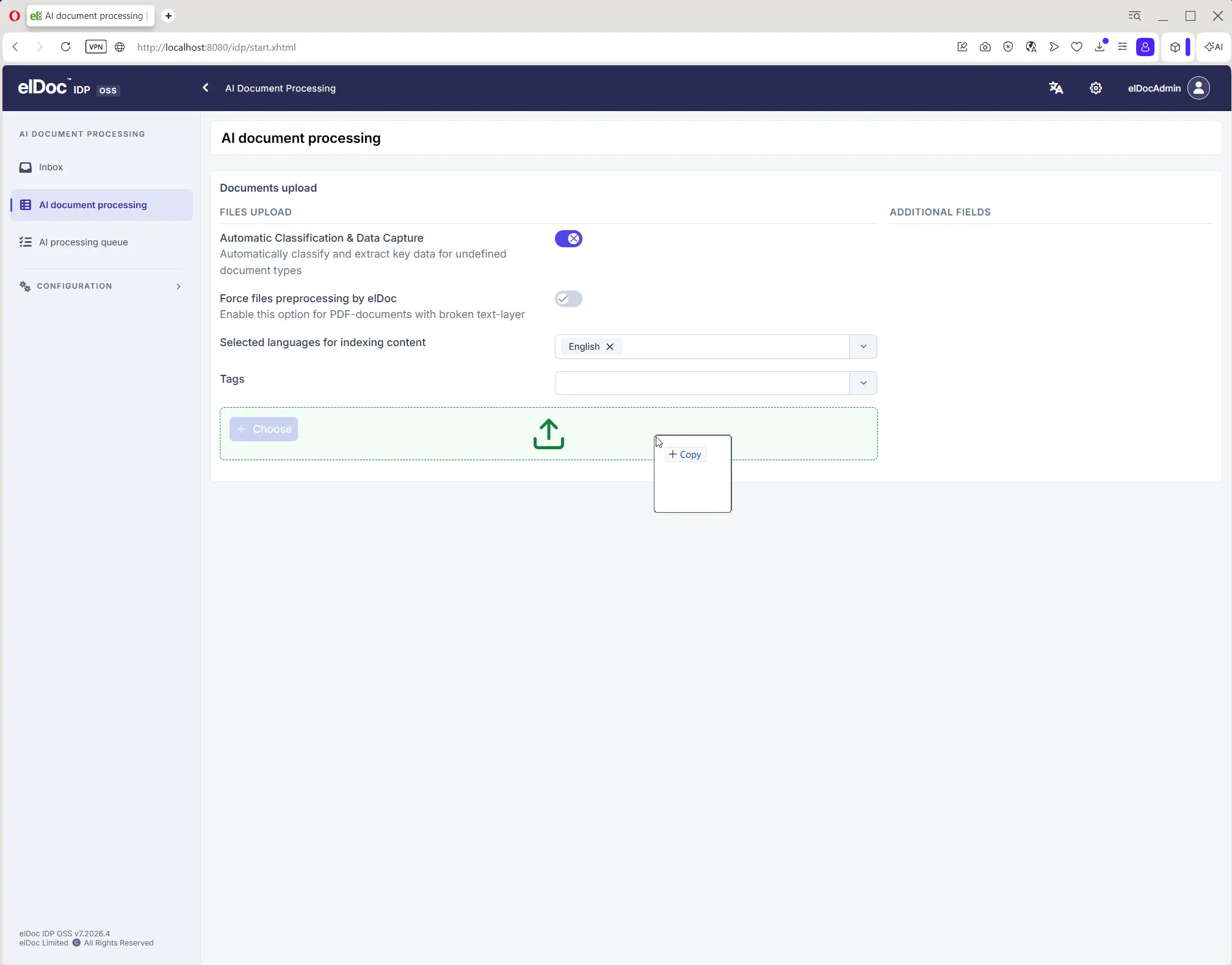
Users upload PDFs, scanned documents, images, or supported multipage TIFF files through the integrated web interface.
The application prepares the uploaded content for subsequent recognition and AI processing.
Step 2 — OCR and Image Preprocessing
Before applying Generative AI, documents may require image preprocessing and text recognition.
elDoc supports multiple OCR approaches, including Tesseract and PaddleOCR, alongside vision-language model capabilities.
Image processing technologies help prepare document content through operations such as normalization, rotation correction, and deskewing.
This stage converts visual document content into information that can be processed by downstream AI components.
Step 3 — AI-Powered Document Classification
Large Language Models analyze the document content to identify its type or category.
This is useful when organizations process different document types, such as invoices, contracts, financial records, application forms, and business correspondence.
Classification enables the document processing workflow to apply appropriate extraction logic based on the identified document type.
Step 4 — Intelligent Data Extraction with LLMs
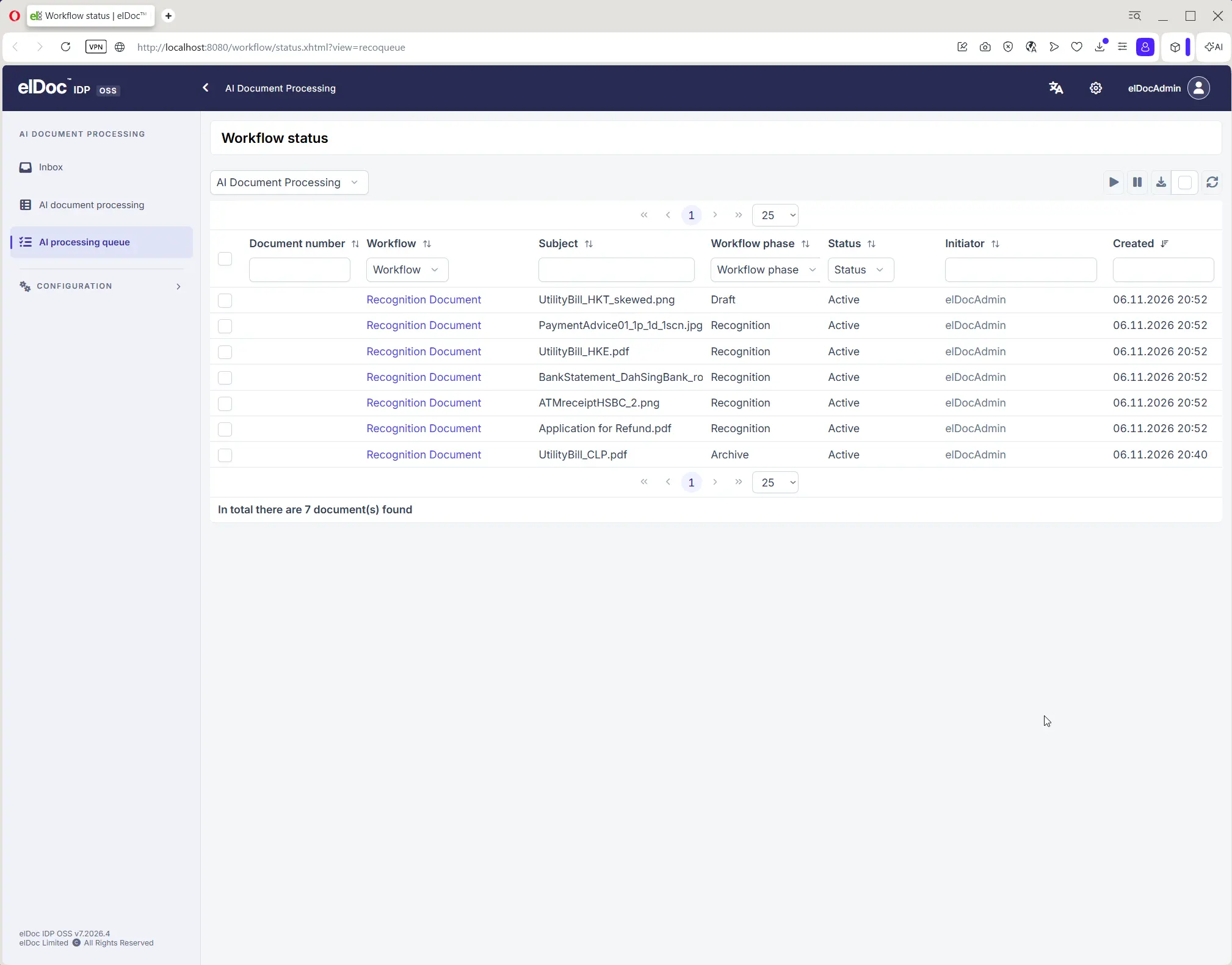
After classification, configured LLMs extract relevant information from document content.
Instead of relying exclusively on fixed templates or predefined document coordinates, LLM-based extraction can interpret document content and identify requested information across varying layouts.
Examples include invoice numbers, supplier names, dates, financial amounts, contract details, and other business-specific fields.
Users can configure the information to be extracted according to their processing requirements.
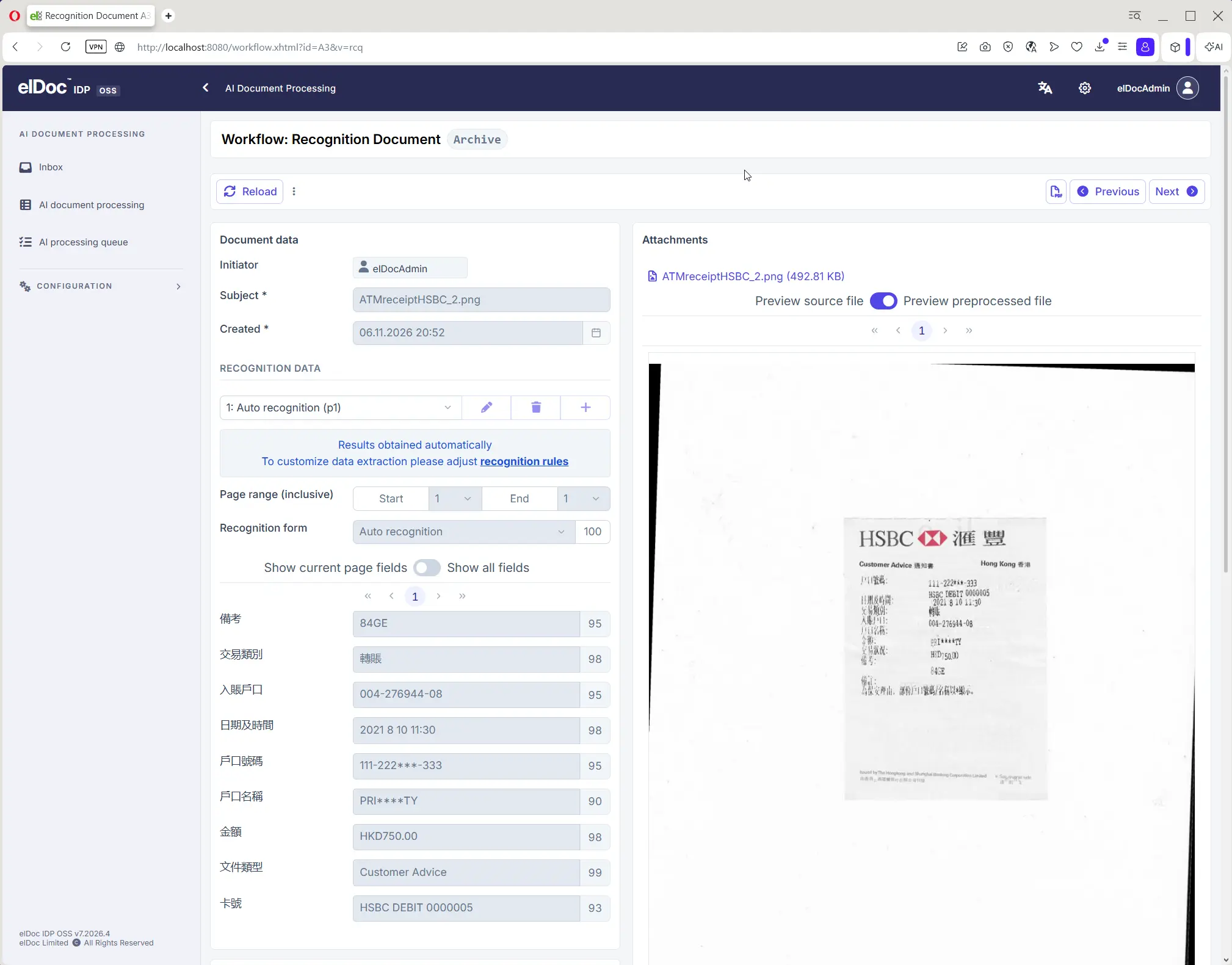
Practical Use Case:
ATM Receipts: Extract transaction dates, amounts, currencies, ATM identifiers, transaction references, and other financial details from receipts generated by different banks and ATM networks.
Practical Use Case:
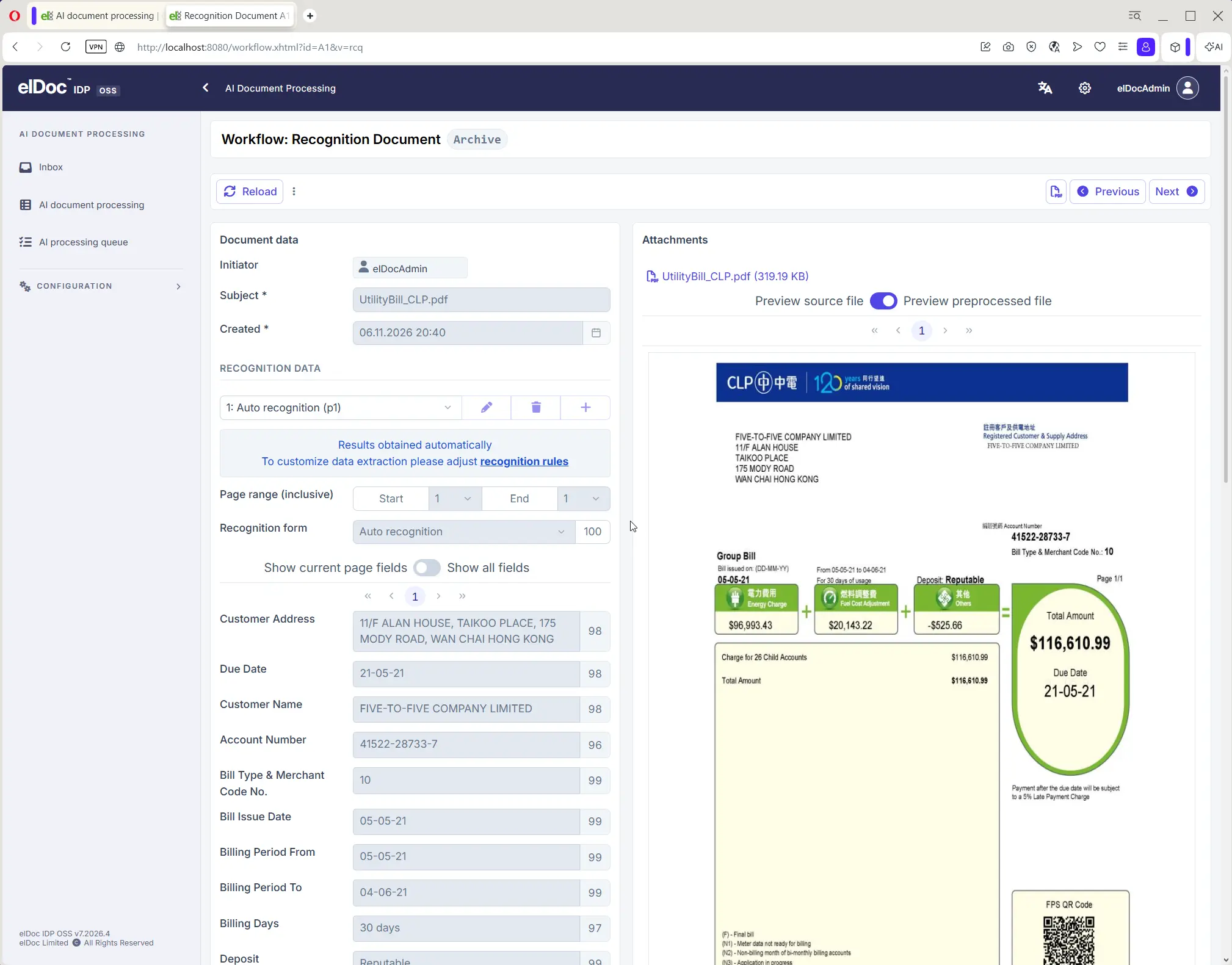
Utility Bills: Capture customer information, account numbers, billing periods, electricity, gas, and water consumption, payment amounts, and due dates from bills issued by different utility providers.
Practical Use Case:
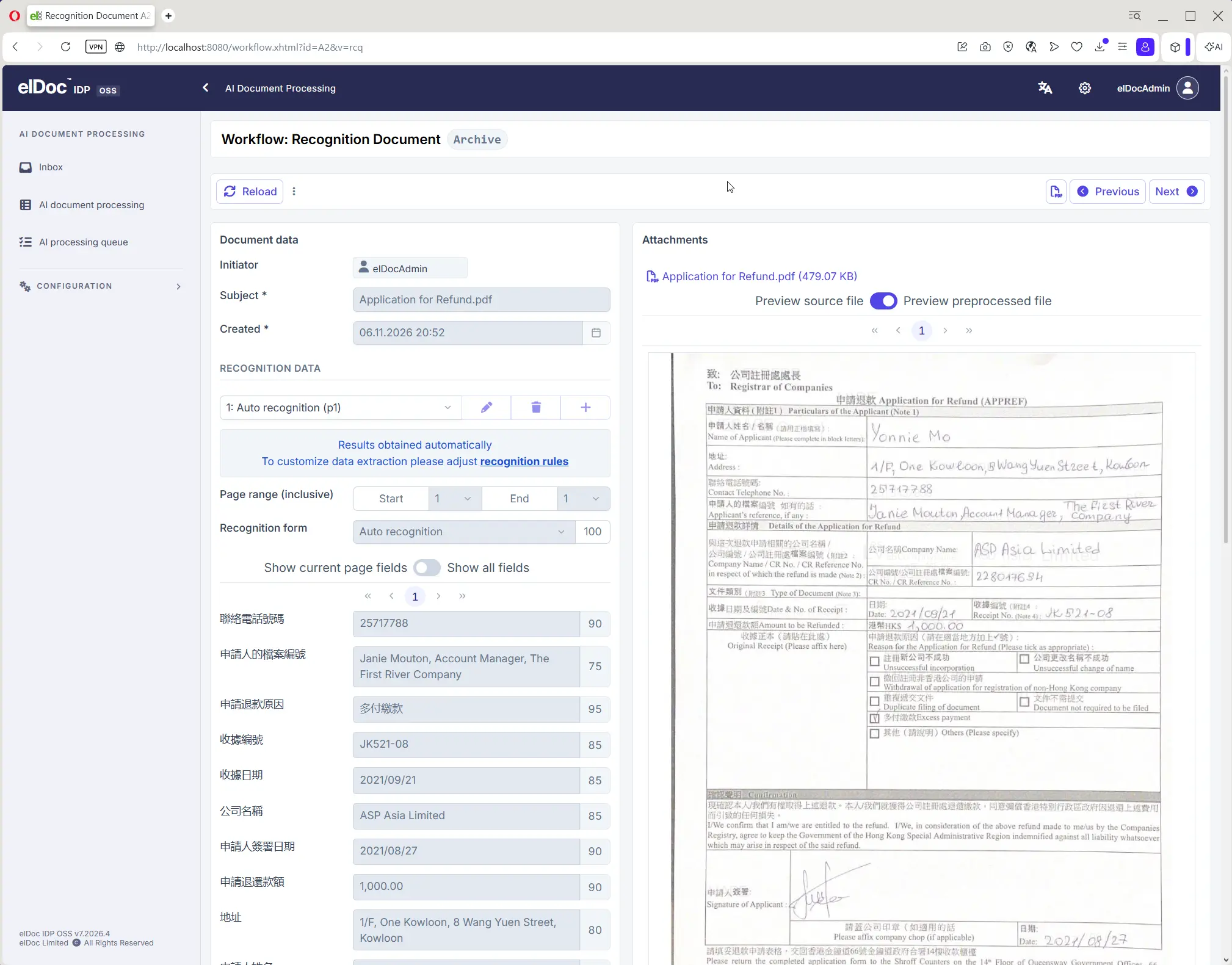
Application Forms: Extract applicant details, identification information, addresses, requested services, and other relevant fields from government, banking, insurance, and corporate application forms.
Unlike traditional template-based OCR solutions, elDoc IDP OSS uses LLM-powered document understanding to extract information without requiring predefined templates for every document layout.
The solution can be configured to process structured, semi-structured, and unstructured documents, including PDFs, scanned documents, images, forms, receipts, invoices, and other business records.
By combining OCR with Generative AI, organizations can define the information they need to extract rather than manually configuring fixed field positions for each document format.
One application. Multiple document types. No document-specific templates required.
Extraction accuracy depends on document quality, model capabilities, and the complexity of the information being processed. Human-in-the-loop validation provides an additional layer of control for business-critical data.
Step 5 — Human-in-the-Loop Validation
AI-generated information may require verification, particularly in financial, administrative, and regulated business processes.
elDoc IDP OSS includes a web-based validation interface that allows users to review extracted information and correct results where necessary.
This provides an important operational layer between AI-generated output and downstream business use.
Step 6 — MongoDB Storage
MongoDB provides the application’s persistence layer for document processing and related application information.
For local evaluation, elDoc IDP OSS supports an embedded MongoDB configuration, reducing the effort required to set up a separate database environment.
Organizations can also configure an externally managed MongoDB deployment according to their infrastructure requirements.
Step 7 — Structured Data Export
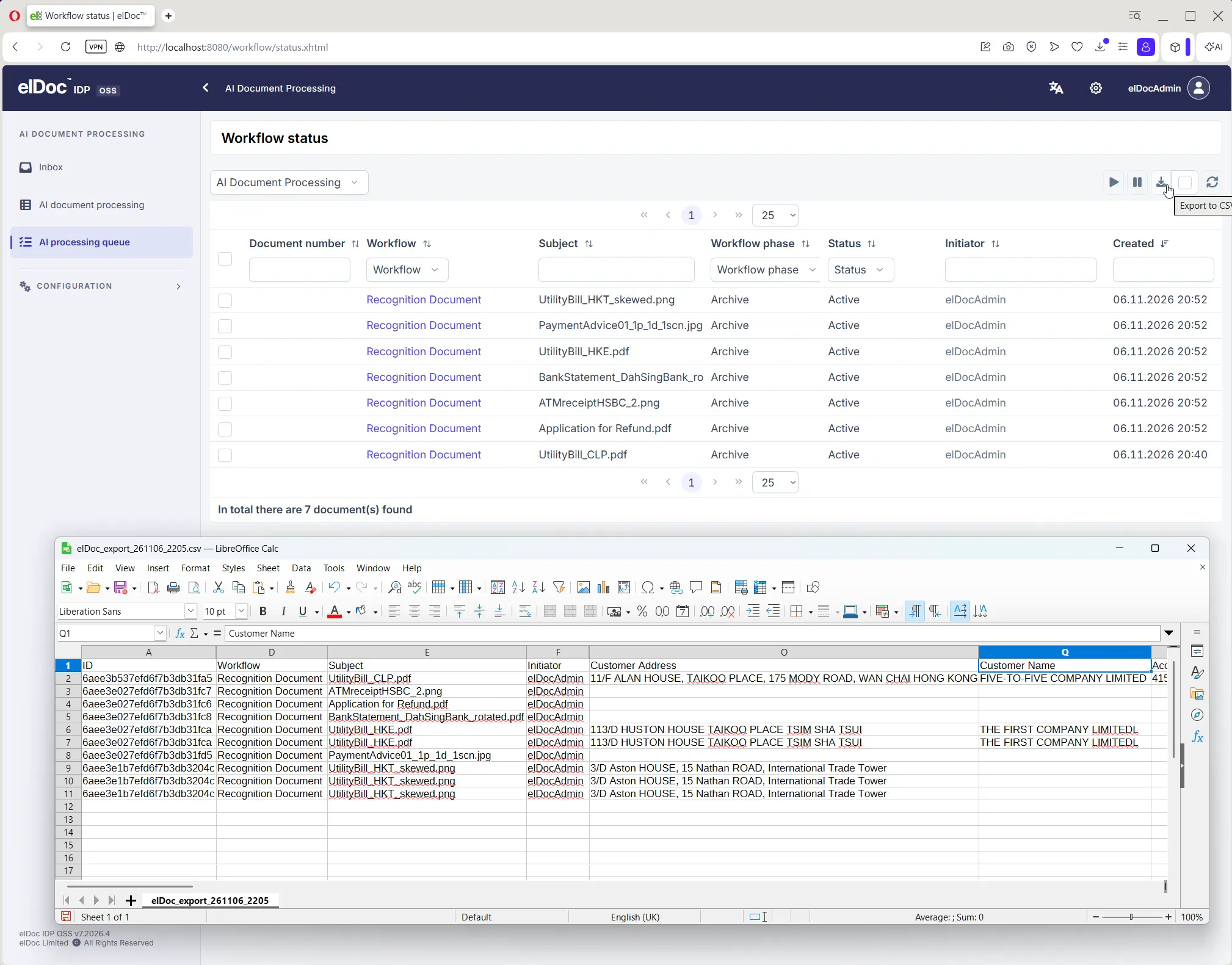
Once extracted information has been reviewed and validated, users can export the results into CSV files.
The resulting structured data can be used for reporting, analysis, or subsequent integration with business applications.
The complete workflow is available within one integrated application — from initial document upload to validated, structured output.
4. PaddleOCR, Tesseract, and elDoc: How the Technologies Work Together
A common misconception in the open-source document processing ecosystem is that OCR engines and Intelligent Document Processing applications are interchangeable.
They are not.
Technologies such as PaddleOCR and Tesseract provide essential text recognition capabilities. They help convert visual document content into machine-readable information.
However, OCR alone does not deliver a complete document processing workflow involving AI classification, business data extraction, human validation, and structured data export.
This is where elDoc IDP OSS provides additional value.
PaddleOCR can be one of the recognition technologies used within elDoc, while elDoc provides the broader application and processing workflow.
For example:
| Capability | OCR Engine | elDoc IDP OSS |
|---|---|---|
| Text recognition | Yes | Integrated |
| Image preprocessing | Engine-dependent | Integrated |
| AI document classification | Requires additional components | Included |
| LLM-based structured data extraction | Requires additional integration | Included |
| Web-based business user interface | Requires additional development | Included |
| Human validation workflow | Requires additional development | Included |
| Processing pipeline and storage | Requires additional integration | Included |
| Structured CSV export | Requires additional development | Included |
The technologies are complementary rather than necessarily competing.
By integrating OCR technologies with AI processing and business workflows, elDoc provides an application layer that enables organizations to use these capabilities together.
5. LLM-Agnostic Architecture: Document Processing Without AI Vendor Lock-In
Generative AI is evolving rapidly, with new models and providers introducing different capabilities, pricing structures, and deployment options.
For enterprise document processing, dependence on a single AI model or provider can create challenges involving costs, performance, data governance, and long-term technology flexibility.
elDoc IDP OSS is designed around an LLM-agnostic architecture, allowing organizations to configure compatible AI models according to their requirements.
Supported LLM Integration Approaches
| AI Provider / Integration | Description |
|---|---|
| OpenRouter | Provides access to multiple AI models through a unified API, enabling organizations to evaluate and switch between models without developing separate integrations for each provider. |
| AWS Bedrock | Enables integration with foundation models available through Amazon’s managed AI infrastructure, supporting enterprise AI deployments. |
| OpenAI-Compatible Endpoints | Supports AI services and model-serving platforms implementing OpenAI-compatible APIs, providing flexibility in model selection and integration. |
| Locally Hosted LLMs | Enables organizations to deploy compatible LLMs within their own infrastructure, supporting fully on-premises AI processing, data sovereignty, and greater control over sensitive information. |
Key advantage: elDoc IDP OSS is LLM-agnostic, allowing organizations to select AI models based on accuracy, performance, cost, security, and data residency requirements without being locked into a single AI provider.
Different processing tasks may require different model capabilities, including tool calling and vision-language understanding. Model selection should therefore consider compatibility with the specific document processing workflow.
This flexibility enables organizations to evaluate AI technologies based on accuracy, performance, processing cost, security, and deployment requirements.
6. Fully On-Premises AI Document Processing with Local LLMs
For banks, insurance companies, government institutions, public-sector organizations, and critical infrastructure operators, document processing frequently involves sensitive or confidential information.
Sending these documents to external cloud-based AI services may not align with internal security policies, regulatory requirements, or data residency obligations.
elDoc IDP OSS supports deployment configurations that combine:
- Locally deployed application services.
- Local OCR processing using supported engines.
- Compatible locally hosted Large Language Models.
- Self-managed MongoDB infrastructure.
- Document processing within an organization’s own IT environment.
This architecture provides a foundation for fully on-premises AI-powered document processing without requiring external cloud LLM inference.
Organizations remain responsible for configuring local model infrastructure, security controls, and application dependencies. Fully isolated environments also require appropriate preparation of installation resources and model assets.
For regulated organizations, the ability to control where documents are stored and where AI processing takes place is an important consideration when implementing Generative AI.
7. MongoDB and the Role of Persistent Storage
Document processing applications require more than AI models and OCR engines.
They also need to manage processing information, document metadata, application configuration, and the results generated during document workflows.
elDoc IDP OSS uses MongoDB as its persistence technology.
For initial evaluation, the application supports an embedded MongoDB setup, allowing users to get started without installing a separate database server.
For more demanding deployments, organizations can connect the application to externally managed MongoDB infrastructure.
This separation allows database operations, backups, monitoring, access controls, and availability requirements to be managed according to enterprise IT policies.
It also illustrates an important distinction between a document parsing library and an operational IDP application: the latter must manage not only document recognition, but also the application state and information required to support an end-to-end processing workflow.
8. Built-In User Interface: From Developer Technology to Business Application
Many open-source AI document processing technologies are primarily accessed through code, command-line tools, or APIs.
While these approaches are useful for developers, organizations often require an interface that business users can operate directly.
elDoc IDP OSS includes a web-based interface developed with Jakarta Faces and PrimeFaces.
The interface allows users to upload documents, configure extraction fields, initiate processing, review AI-generated information, correct results, and export structured data.
This means organizations do not need to develop a separate frontend simply to begin using the document processing workflow.
The built-in interface is especially valuable for business teams evaluating AI-powered document automation, as well as enterprise IT departments seeking to reduce implementation complexity.
Multilingual User Interface
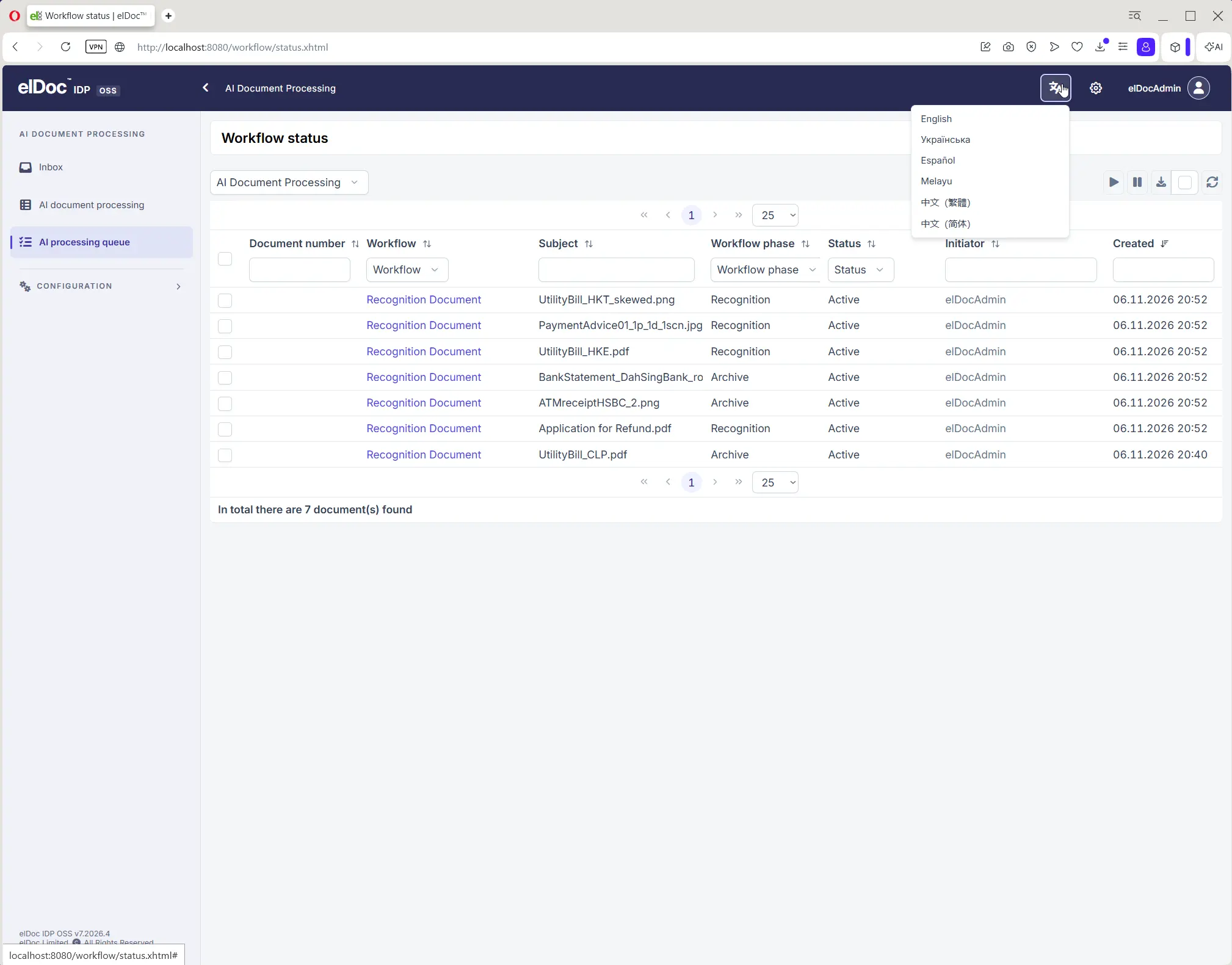
elDoc IDP OSS provides a multilingual web-based user interface, enabling organizations and users across different regions to interact with the application in their preferred language.
The interface currently supports six languages:
| Language | Native Name |
|---|---|
| English | English |
| Ukrainian | Українська |
| Spanish | Español |
| Malay | Melayu |
| Traditional Chinese | 中文(繁體) |
| Simplified Chinese | 中文(简体) |
Key advantage: Multilingual interface support makes elDoc IDP OSS more accessible to international enterprises, government institutions, and public-sector organizations, supporting adoption across geographically distributed teams.
Note: User interface localization is separate from document recognition and extraction language capabilities, which depend on the configured OCR engines and LLMs.
9. Open Source as a Foundation for Enterprise GenAI Document Intelligence
elDoc IDP OSS represents the open-source Intelligent Document Processing module within the broader elDoc GenAI Document Intelligence Platform.
The enterprise platform extends document processing with additional capabilities, including:
- Generative AI for Documents.
- Agentic Retrieval-Augmented Generation (RAG).
- AI Workflow Automation
- AI Document Agents and AI Co-Workers.
- Multi-LLM Orchestration.
- AI-powered document chat and semantic search.
- Enterprise document management and workflow automation.
- OpenAPI-based integration with enterprise systems.
- Enterprise security, administration, and AI governance capabilities.
Designed for highly regulated environments, the broader platform supports on-premises, private cloud, and air-gapped deployment options, helping organizations maintain control over sensitive documents, AI workloads, and infrastructure.
The open-source release provides a practical entry point into AI-powered document processing, while the enterprise platform addresses more extensive document intelligence and automation requirements.
Open-Source AI Document Processing Beyond SDKs and Toolkits
Open-source OCR engines, document parsing libraries, and LLM frameworks play an essential role in modern AI document processing.
However, organizations looking to automate document-intensive business operations need more than isolated technical components.
They need a complete workflow that connects document ingestion, recognition, classification, data extraction, validation, storage, and export.
elDoc IDP OSS brings these capabilities together within a ready-to-deploy, open-source application.
By combining Java-based application services, OCR technologies such as PaddleOCR and Tesseract, MongoDB persistence, configurable LLM integrations, and an integrated web interface, elDoc provides a practical foundation for AI-powered document automation.
With support for locally hosted LLMs and on-premises deployment, organizations can also pursue document processing strategies aligned with their security, data residency, and technology independence requirements.
Not just an SDK. Not another OCR library or developer toolkit. A complete open-source Intelligent Document Processing application built on experience from enterprise and public-sector document automation.
Get Started with elDoc Open-Source Intelligent Document Processing
Explore. Deploy. Customize. Contribute.
Explore the source code, technical documentation, configuration examples, and installation instructions.
GitHub: https://github.com/elDocAI/elDoc-idp-oss/
License: GNU Affero General Public License v3.0 (AGPL-3.0), with separate commercial licensing options available.
We invite organizations, enterprise IT teams, government institutions, and the open-source community to evaluate elDoc IDP OSS, experiment with different AI models, and contribute to the development of transparent, accessible, and enterprise-ready document intelligence.