
How Banks Can Deploy AI Co-workers for KYC/KYB: Three Practical Verification Use Cases

From document cross-checking and duplicate detection to shareholder and Ultimate Beneficial Owner (UBO) verification — how elDoc enables banks to automate complex KYC/KYB operations using natural language AI Co-workers.
Banks have invested heavily in digitizing customer onboarding, Know Your Customer (KYC), and Know Your Business (KYB) operations. Yet many verification activities remain dependent on manual document reviews, information comparisons, exception investigations, and compliance approvals.
Traditional Intelligent Document Processing (IDP) technologies help banks extract information from identity documents, corporate registries, financial statements, and other records. But extracting data is only part of the process.
The greater operational challenge begins when banks need to verify whether information is accurate, consistent, complete, and aligned with existing customer records.
This is where AI Co-workers introduce a different approach.
With elDoc, banks can configure AI Co-workers through natural language instructions to analyze KYC/KYB documentation, compare information across multiple sources, identify discrepancies, and initiate verification workflows.
Instead of building separate scripts for every document comparison or business verification scenario, banks can describe the required tasks in natural language and incorporate AI Co-workers into governed, end-to-end document workflows.
This article explores three practical banking use cases:
- Document Cross-Check & Consistency Verification — identifying conflicting, missing, or outdated information across KYC/KYB documentation.
- Duplicate Detection & Escalation — detecting potential duplicate customers, corporate entities, identity documents, and shareholder records.
- Shareholder & UBO Information Verification — analyzing ownership structures and verifying shareholder information across corporate documentation.
These are representative banking implementation scenarios illustrating elDoc’s capabilities, rather than claims about specific customer deployments.
1. Why KYC/KYB Automation Needs to Move Beyond Data Extraction
Consider a corporate customer submitting a new business account application.
The bank receives a collection of documents, potentially including a Certificate of Incorporation, Business Registration Certificate, Company Registry Extract, shareholder register, ownership declaration, directors’ identification documents, utility bills, and bank statements.
AI-powered data capture can extract company names, registration numbers, addresses, dates, shareholder names, and ownership percentages.
However, compliance teams still need answers to more complex questions:
- Does the registered company name match across all documents?
- Are the directors listed in the application consistent with the corporate registry?
- Is the registered business address consistent with supporting documentation?
- Has this customer or company already been registered?
- Do the shareholders and ownership percentages reconcile?
- Are the declared UBOs consistent with the documented ownership structure?
- Which discrepancies require investigation before onboarding can proceed?
These questions require more than OCR or individual document extraction. They involve contextual interpretation, cross-document reasoning, structured comparisons, and controlled decision-making.
From data extraction to AI-powered verification
| Traditional document automation | AI Co-worker-enabled KYC/KYB |
|---|---|
| Extracts information from individual documents | Analyzes information across multiple documents and authorized records |
| Captures predefined fields | Interprets natural language verification instructions |
| Applies configured validation rules | Combines contextual document analysis with defined verification rules |
| Identifies missing or low-confidence fields | Investigates inconsistencies and identifies potential discrepancies |
| Transfers extracted data to downstream systems | Produces verification findings and initiates configured workflows |
| Requires manual comparison of related records | Automates repeatable cross-document verification tasks |
| Relies on separate tools for review and approval | Connects AI verification with human review and approval workflows |
The objective is not to remove compliance officers from the process.
It is to automate repetitive verification work so banking employees can focus on exceptions, risk assessment, and decisions requiring human judgment.
2. How elDoc AI Co-workers Operate Within KYC/KYB Workflows
elDoc is designed for highly regulated enterprise environments where AI document processing must operate within established security, governance, and access-control requirements.
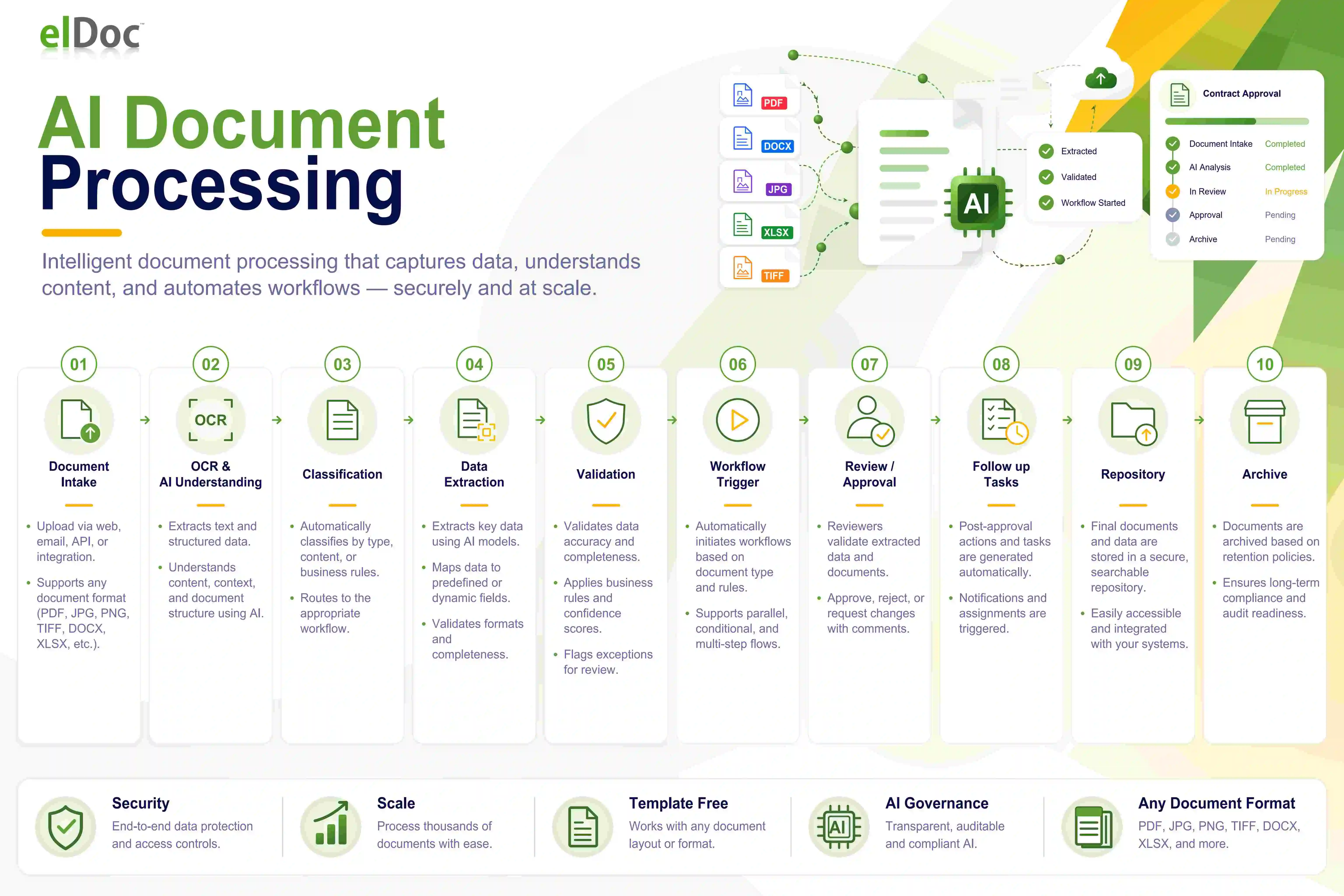
The platform combines document intake, OCR, Generative AI, AI Data Capture, AI Co-workers, workflow automation, human approvals, and secure document repositories.
Natural language becomes the starting point for verification
One of the defining capabilities of elDoc AI Co-workers is that business users can describe verification tasks in natural language.
For example:
Review all submitted company documents, compare registration details and shareholder information, identify discrepancies, and escalate cases requiring further investigation.
An AI Co-worker uses this instruction to perform its assigned task within the documents, data sources, permissions, and workflow configuration available to it.
The instruction does not replace security policies, authorized data access, or deterministic compliance rules. Instead, it provides the business context for the AI-powered verification process.
Banks can create multiple AI Co-workers, assign them different responsibilities, and integrate them into sequential or parallel verification workflows.
The following three scenarios demonstrate how this works in practice.
Use Case 1: Document Cross-Check & Consistency Verification
Automating KYC/KYB document consistency checks
The banking challenge
During corporate onboarding, banks frequently receive information about the same customer from multiple sources.
A company name may appear in the Certificate of Incorporation, Business Registration Certificate, account application, and company registry extract.
Similarly, director names, registered addresses, company registration numbers, and identification details may be repeated across multiple documents.
Even when information has been extracted automatically, employees may still need to compare these details manually.
The complexity increases when documents contain outdated information, different naming conventions, incomplete fields, or conflicting records.
How banks can configure the elDoc AI Co-worker
With elDoc, banks can configure AI Co-workers simply by describing verification tasks and business rules in natural language. No coding or complex configuration is required to define the instructions. Just specify what needs to be checked, which information to compare, and what actions to take when discrepancies are identified.
Here is an example of a natural language prompt for an AI Co-worker:
AI Co-worker Instruction #1: Document Cross-Check & Consistency Verification
Review the complete KYC/KYB document package and cross-check all submitted documents against each other and existing customer records. Identify any missing, outdated, conflicting, or inconsistent information across the documents.
If discrepancies are detected, flag the affected documents and trigger the Document Discrepancy Review Workflow for further investigation and resolution.
Once configured, the AI Co-worker executes the verification task within its authorized data access and workflow settings. It analyzes the relevant documents, compares information, identifies potential discrepancies, and records findings with supporting references.
When inconsistencies are detected, elDoc can automatically initiate the predefined review workflow, assigning the case to authorized banking employees for investigation and resolution.
From natural language instructions to automated document verification and exception handling — all within one secure, governed workflow.
Use Case 2: Duplicate Detection & Escalation
Beyond checking document consistency, AI Co-workers can take verification a step further — identifying potential duplicate customers, corporate entities, shareholders, and previously submitted documents.
During KYC/KYB onboarding, the AI Co-worker can compare newly submitted information against existing customer records, recognizing potential matches even when names, document formats, or company details differ.
Banks can define these verification requirements through a simple natural language prompt, specifying what to compare and how potential duplicates should be handled.
Here is an example of a natural language prompt for an AI Co-worker:
AI Co-worker Instruction #2: Duplicate Detection & Escalation
Review all submitted KYC/KYB documents and compare them against existing customer records to identify potential duplicate documents, entities, shareholders, or previously registered customers.
If potential duplicates are identified, flag the matching records, provide details of the suspected duplication, and trigger the Duplicate Detection & Escalation Workflow for further review and verification.
Once the task is initiated, the AI Co-worker analyzes submitted documents, cross-references information against accessible customer records, and identifies potential matches based on company registration numbers, identification details, names, and other relevant attributes.
When potential duplicates are detected, elDoc can automatically trigger the predefined escalation workflow, providing supporting references and routing the case to authorized banking employees for further investigation.
The result: Automated duplicate detection, faster identification of potential matches, and structured exception management — all within one secure, governed workflow.
Use Case 3: Shareholder & UBO Information Verification
Corporate KYC/KYB verification becomes considerably more complex when banks need to validate shareholder information, ownership percentages, and Ultimate Beneficial Owner (UBO) details across multiple corporate documents.
Information may be distributed across shareholder registers, company registry extracts, incorporation documents, and ownership declarations. In more complex structures, ownership can extend across several intermediary companies, making manual verification particularly time-consuming.
AI Co-workers can analyze these documents together, compare shareholder information, identify inconsistencies, and examine direct and indirect ownership relationships.
As with the previous use cases, the verification task can be defined through natural language instructions.
Here is an example of a natural language prompt for an AI Co-worker:
AI Co-worker Instruction #3: Shareholder & UBO Information Verification
Verify that all shareholder names, ownership percentages, company details, registration numbers, and Ultimate Beneficial Owner (UBO) information are accurately and consistently stated across all relevant KYC/KYB documents, including corporate registries, shareholder registers, ownership structures, and incorporation documents.
If any inconsistencies, ownership discrepancies, missing shareholders, or conflicting UBO information are identified, flag the relevant records and trigger the Shareholder & UBO Verification Workflow for further investigation and remediation.
Once initiated, the AI Co-worker analyzes corporate documentation, extracts relevant shareholder and ownership information, and cross-checks details across available sources.
For multi-layered corporate structures, it can also analyze direct and indirect ownership relationships, calculate ownership percentages where sufficient information is available, and identify missing shareholders, conflicting ownership declarations, or incomplete ownership chains.
When discrepancies are identified, elDoc can automatically initiate the predefined verification workflow, providing supporting document references and assigning the case to authorized compliance officers for investigation and resolution. Final UBO determinations remain subject to applicable regulatory requirements and human review.
The result: More efficient shareholder verification, automated ownership consistency checks, and structured UBO exception handling — all within one secure, governed workflow.
Orchestrating Multiple AI Co-workers Within One KYC/KYB Workflow
The value of AI Co-workers becomes more significant when banks combine multiple verification responsibilities within a single, coordinated process.
Rather than operating three independent automation tools, a bank can design a KYC/KYB workflow that brings together document processing, specialized AI verification tasks, exception handling, and human approvals.
Three AI Co-workers. One connected verification process.
| AI Co-worker | Primary responsibility | Workflow triggered when exceptions arise |
|---|---|---|
| Document Cross-Check | Verify consistency across documents and customer information | Document Discrepancy Review |
| Duplicate Detection | Identify potential duplicate customers, entities, and documents | Duplicate Detection & Escalation |
| Shareholder & UBO Verification | Compare shareholder information and assess ownership structures | Shareholder & UBO Verification |
Depending on the bank’s requirements, verification tasks can be configured to run sequentially or in parallel.
For example, duplicate detection may run alongside document consistency checks, while shareholder verification may require additional corporate information before it can be completed.
What Changes for Banks? The Operational Value of AI Co-workers
The transition from document extraction to AI-powered verification can change how banks organize document-intensive KYC/KYB activities.
| Banking operation | Traditional approach | AI Co-worker-enabled approach |
|---|---|---|
| Document intake | Manual sorting and document identification | AI classification and document understanding |
| Data capture | Manual entry or conventional OCR extraction | Context-aware AI Data Capture |
| Consistency verification | Employees compare documents individually | AI Co-workers perform cross-document checks |
| Duplicate detection | Manual customer record searches | AI-assisted comparison across authorized records |
| Shareholder verification | Manual reconciliation of ownership documents | AI-supported ownership analysis and discrepancy identification |
| Exception handling | Email exchanges and disconnected review activities | Configured exception workflows |
| Approvals | Separate manual approval processes | Integrated human review and approval stages |
| Document governance | Records distributed across multiple repositories | Secure, structured document management |
| Audit preparation | Manual collection of supporting evidence | Accessible document histories and recorded workflow activities |
Explore AI Co-workers for Banking KYC/KYB With elDoc
Discover how elDoc can help your bank automate document consistency checks, duplicate detection, and shareholder and UBO verification within a secure, enterprise-controlled environment.