
AI Risks and Controls in Banking — How elDoc Delivers Secure, Governed Enterprise AI

Generative AI is changing how banks process documents, analyze financial information, manage customer records, and automate business operations. But as financial institutions move from AI experimentation to enterprise-wide deployment, a critical question emerges: How can banks scale AI without compromising security, regulatory accountability, data sovereignty, or operational control?
The challenge extends beyond protecting the Large Language Model (LLM). Enterprise AI introduces new risks across information retrieval, document processing, AI-generated outputs, autonomous actions, third-party infrastructure, and the interaction between AI systems and established banking processes.
For financial institutions, these risks cannot be addressed through model-level safeguards alone.
A secure banking AI architecture must govern what AI can access, which information it can process, what actions it can perform, how its outputs are validated, and how every consequential activity can be traced to an accountable user or process.
This is where AI governance must become an integral part of enterprise security architecture rather than an additional layer of policy documentation.
elDoc, an enterprise-grade GenAI Document Intelligence Platform, addresses this challenge by combining secure document management, authorization-aware Retrieval-Augmented Generation (RAG), AI Document Agents, Human-in-the-Loop (HITL) validation, Multi-LLM orchestration, and infrastructure deployment flexibility within a unified enterprise environment.
This article examines the principal AI risks facing banks, the controls needed to manage them, and how elDoc helps financial institutions establish a defense-in-depth architecture for secure and governed AI operations.
1. Why AI Risk Management Is Becoming a Banking Priority
Banks already operate within sophisticated frameworks for cybersecurity, information governance, operational resilience, third-party risk management, and regulatory compliance.
Generative AI introduces an additional challenge: AI systems do not simply store or transmit information. They interpret it, combine it, generate new content from it, and increasingly initiate actions based on it.
Consider a banking AI assistant connected to customer onboarding files, credit applications, internal compliance policies, and financial statements.
Even if the underlying LLM is technically secure, the bank must still address several questions:
- Can the AI retrieve customer documents that the requesting employee is not authorized to access?
- Could a malicious instruction embedded in a document influence the AI’s behavior?
- Can confidential banking information be transmitted to an external model provider?
- How does the bank verify that AI-extracted financial data is accurate?
- Can an AI Agent modify or approve a document without appropriate authorization?
- Who is accountable when AI-generated information contributes to an incorrect decision?
- Can the bank reconstruct which documents, users, and approvals were involved in an AI-assisted process?
- What happens when an AI provider becomes unavailable or a model no longer meets the bank’s requirements?
These are not isolated technical concerns. They affect operational risk, customer confidentiality, internal controls, regulatory obligations, and institutional accountability.
Three Dimensions of Banking AI Risk
| Risk Dimension | Key Risk | Potential Banking Impact |
|---|---|---|
| 1. AI Information Access Risk | AI retrieves, processes, or exposes information beyond the requesting user’s authorization. | Unauthorized disclosure of confidential customer records, financial information, and restricted internal documents. |
| 2. AI Output and Decision Risk | AI generates inaccurate, incomplete, misleading, or improperly validated information. | Incorrect financial analysis, unreliable compliance assessments, and flawed AI-assisted business decisions. |
| 3. AI Action and Autonomy Risk | AI Agents execute unauthorized, unintended, or insufficiently supervised operations. | Unauthorized document modifications, improper workflow transitions, and execution of consequential business activities without appropriate oversight. |
Key takeaway: An effective banking AI governance architecture must address all three dimensions—information access, output reliability, and AI autonomy—while preserving the security, accountability, and operational controls already established across the financial institution.
2. From Model Security to Enterprise AI Governance
Traditional cybersecurity controls protect infrastructure, applications, identities, networks, and data.
These controls remain essential, but Generative AI creates additional pathways through which information can be retrieved, interpreted, transformed, and acted upon.
For example, a bank may have robust Role-Based Access Control (RBAC) within its document management system. However, if an AI assistant retrieves documents through an unrestricted service account, existing document permissions may not be enforced during AI interactions.
Similarly, an LLM may be configured to refuse unauthorized requests, but prompt instructions alone cannot substitute for application-enforced authorization.
The fundamental principle is that AI must operate within the bank’s established security and authorization boundaries—not create an independent path around them.
This requires multiple layers of protection.
| Security Layer | Governance Requirement |
|---|---|
| Identity and authentication | Establish who is requesting AI functionality |
| Authorization | Enforce user, role, group, and document-level permissions |
| Information retrieval | Restrict AI context to authorized enterprise information |
| AI processing | Govern model access, data handling, and execution environments |
| Output validation | Verify AI-generated information before consequential use |
| AI actions | Restrict actions to explicitly authorized operations |
| Human oversight | Require appropriate review and approval |
| Auditability | Record relevant document, user, and AI-assisted activities |
| Infrastructure | Maintain availability, sovereignty, and operational resilience |
The controls must work together.
A secure model cannot compensate for unrestricted document access. Strong authentication cannot prevent inaccurate AI-generated information. Detailed audit logs cannot prevent an unauthorized action that has already occurred.
Consequently, banking AI security must be designed as an integrated control architecture spanning the complete document and AI lifecycle.
3. The Banking AI Risk Landscape: Where Controls Matter Most
3.1 Customer information confidentiality and unauthorized access
Banks manage highly sensitive information, including customer identities, financial statements, account-related documentation, transaction records, and confidential business information.
When AI is connected to enterprise repositories, the risk is not limited to a data breach. Information may also be exposed through legitimate-looking AI responses that combine content from sources the requesting user should not access.
How elDoc addresses the risk
elDoc combines identity authentication, RBAC, document-level access controls, and authorization-aware RAG.
Rather than treating the LLM as an unrestricted interface to enterprise information, elDoc enforces access permissions before document content or retrieved context is supplied to AI processing.
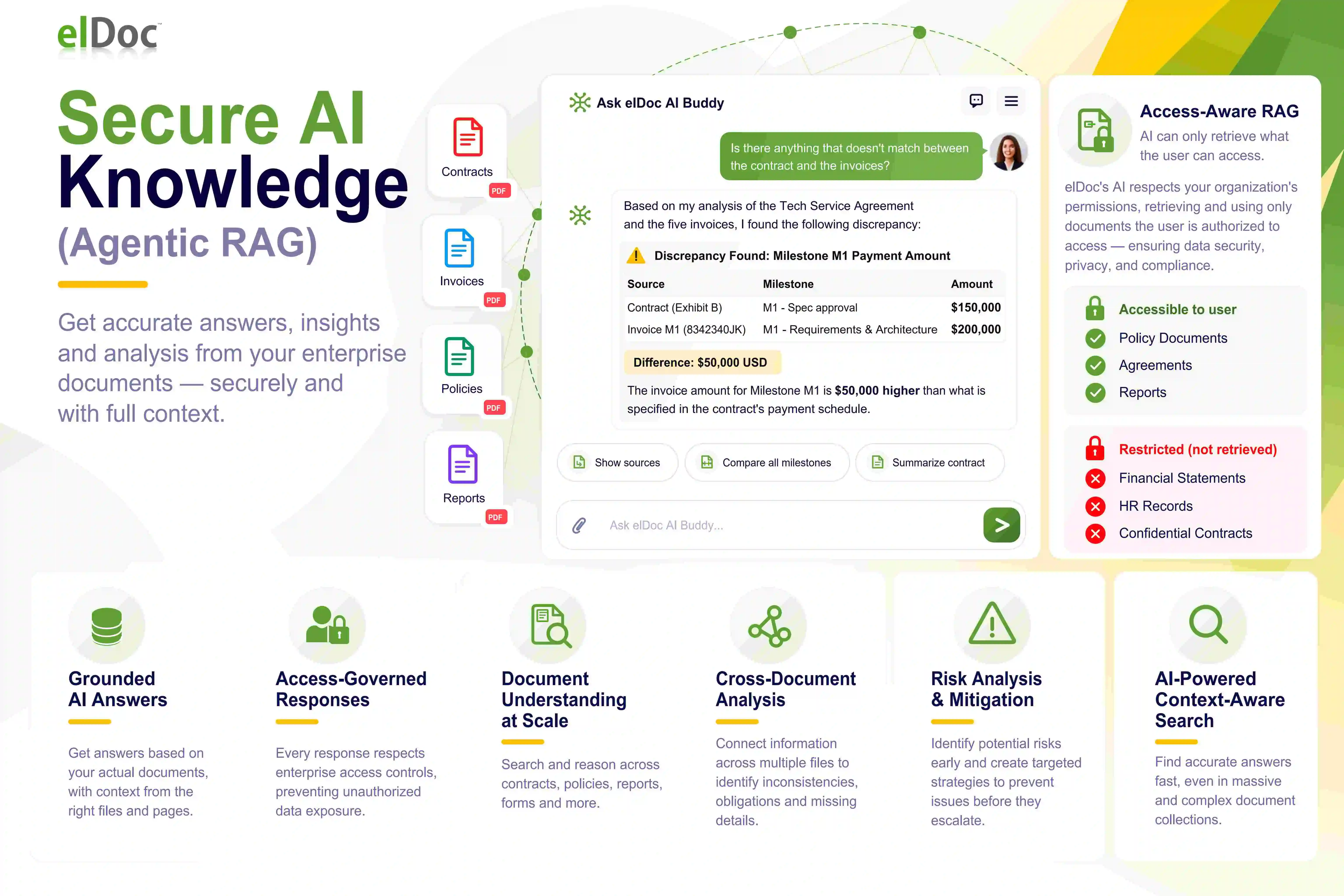
The objective is to ensure that AI-assisted information retrieval respects the same authorization boundaries that govern access to enterprise documents.
3.2 AI hallucinations and unreliable financial information
Generative AI can produce plausible but incorrect information.
In banking, this can become particularly consequential when AI is used to summarize financial statements, extract information from loan applications, analyze compliance documentation, or prepare internal reports.
A generated answer may appear authoritative even when the underlying source information is incomplete, outdated, or incorrectly interpreted.
How elDoc addresses the risk
elDoc supports RAG grounding, source references, field-level data scoring, configurable validation thresholds, and Human-in-the-Loop review.
These controls help authorized users verify information against enterprise source documents and identify extracted data requiring additional validation.
However, grounding and confidence scores do not guarantee factual accuracy. Banks must still define review criteria, validation rules, and appropriate approval requirements for consequential decisions.
3.3 Prompt injection and malicious document instructions
Prompt injection is a distinct AI security concern because instructions may originate from content that an AI system is supposed to analyze rather than obey.
For example, a malicious instruction could be embedded in a document uploaded for customer onboarding or included in an external information source retrieved by an AI assistant.
The attacker may attempt to influence the AI to reveal confidential information, disregard instructions, or perform an unauthorized operation.
How elDoc addresses the risk
elDoc applies application-enforced authorization independently of LLM prompts, controlled RAG context, permission enforcement, and controlled AI actions.
These controls reduce reliance on the LLM’s ability to recognize malicious instructions. Retrieved document content cannot independently grant new permissions or expand the AI Agent’s system authority.
Prompt injection remains an evolving threat, and application controls should be complemented by testing, monitoring, and secure configuration.
3.4 AI Agents and unauthorized actions
As banks adopt Agentic AI, systems may move beyond generating answers to supporting document changes, classification, workflow operations, and multi-step processing.
This creates a different risk profile.
An AI-generated summary can be reviewed before use. An AI Agent with unrestricted execution privileges could potentially modify a document or initiate an operational step before a user notices an error.
How elDoc addresses the risk
elDoc supports controlled AI actions, supervised AI operations, and Human-in-the-Loop approval.
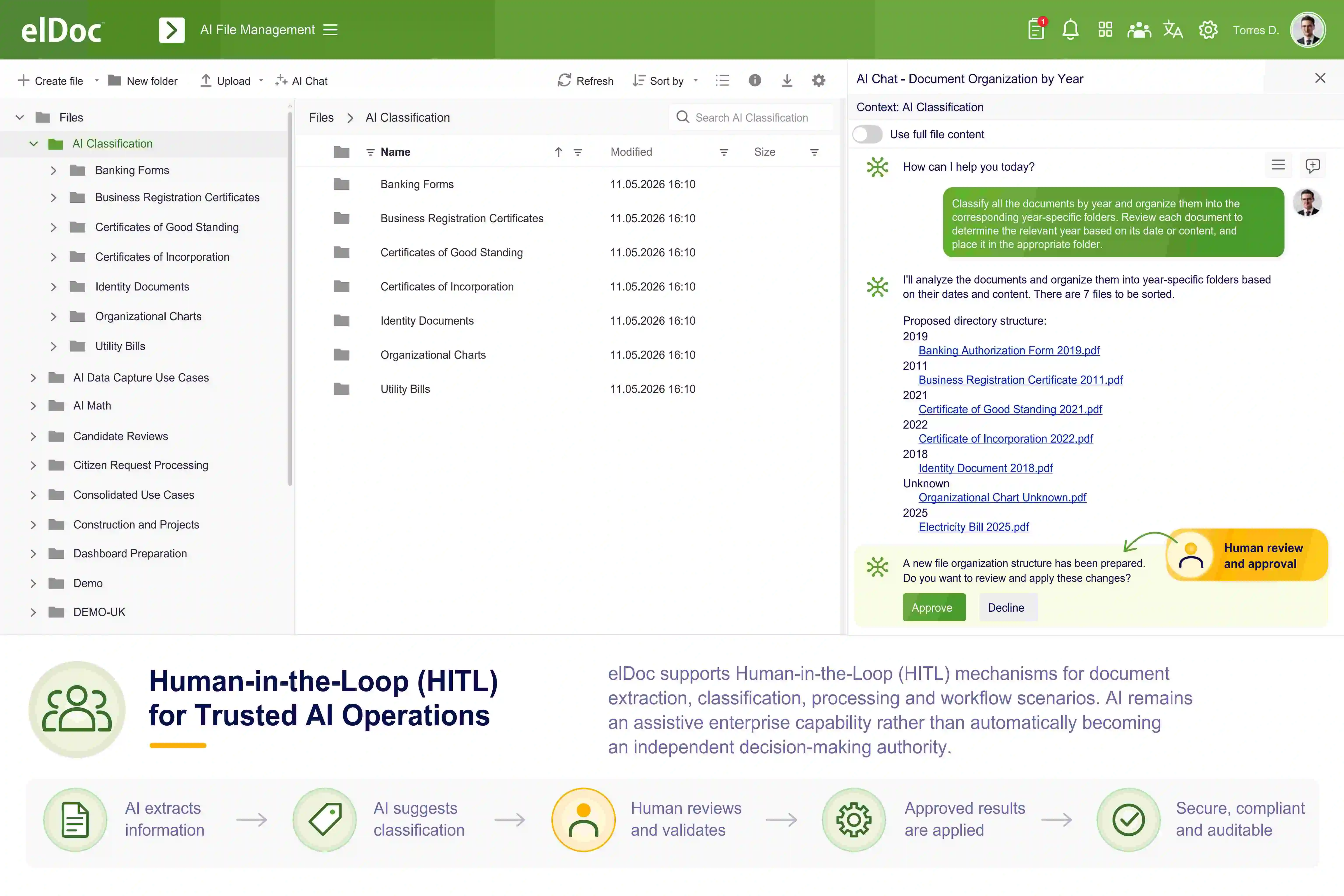
Consequential activities can be subject to authorization, validation, and human review before execution.
This supports a governance principle particularly relevant to banking:
AI may assist with execution, but authority must remain governed by enterprise policies, permissions, and accountable human oversight.
3.5 Data sovereignty and external AI dependency
Banks operating across jurisdictions must consider where information is stored, processed, transmitted, and accessed.
Using external AI services may introduce additional considerations relating to data residency, third-party dependencies, confidentiality, and operational continuity.
How elDoc addresses the risk
elDoc supports on-premises, sovereign, and fully air-gapped AI deployments, allowing banking institutions to operate AI infrastructure within their approved environments.
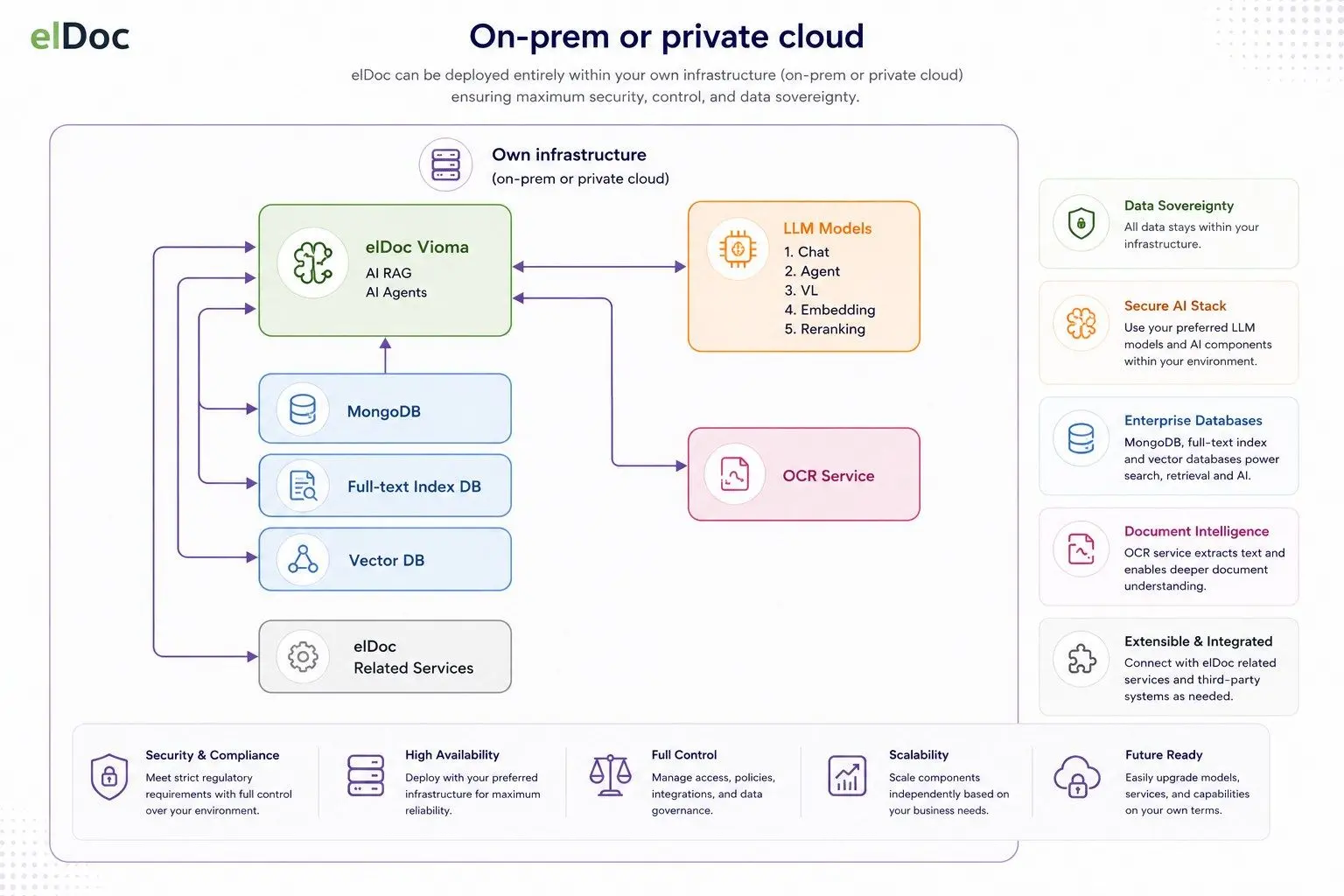
Its LLM-agnostic architecture also enables organizations to select or replace models according to their security, sovereignty, performance, and operational requirements.
The actual data-flow and residency position depends on the models, integrations, infrastructure, and deployment configuration selected by the bank.
4. Banking AI Risk and Control Overview
The following overview connects common banking AI risks with the control mechanisms available within elDoc.
| Banking AI Risk | Potential Impact | elDoc Control |
|---|---|---|
| Unauthorized AI access | Disclosure of confidential customer or banking documents | MFA, SSO, RBAC, document permissions |
| Sensitive information exposure | Confidential information appears in unauthorized AI responses | Authorization-aware RAG and controlled LLM interfaces |
| Prompt injection | Malicious content attempts to manipulate AI behavior | Application-enforced authorization and controlled AI actions |
| Data sovereignty | Information is processed outside approved infrastructure | On-premises, sovereign, and air-gapped deployment |
| Hallucinations | Inaccurate AI outputs influence banking operations | RAG grounding, source references, human verification |
| Incorrect data extraction | Incorrect financial or customer data enters downstream processes | Field-level scoring, validation thresholds, HITL |
| Excessive AI autonomy | AI performs unintended or unauthorized actions | Controlled AI actions and human approvals |
| Inadequate accountability | AI-assisted activities cannot be reconstructed | Audit logging and user-linked activity tracking |
| Document integrity | Documents are changed without sufficient traceability | Document version control and audit trails |
| External AI dependency | Provider availability or security requirements affect operations | LLM-agnostic architecture and controlled AI integrations |
| AI resource consumption | Excessive AI workloads affect cost or availability | Usage monitoring and resource controls |
| Information leakage through sharing | Sensitive documents are redistributed beyond their intended audience | Granular sharing restrictions, watermarking, audit trails |
These controls do not operate independently. Their effectiveness depends on how they are configured and integrated into the bank’s operational, security, and governance processes.
5. Banking AI Governance and Regulatory Expectations
For regulated financial institutions, AI governance cannot be separated from broader requirements for operational resilience, data protection, internal controls, and accountable decision-making.
Although regulations differ across jurisdictions, several established frameworks provide useful reference points for developing an enterprise AI control architecture.
EU Digital Operational Resilience Act (DORA)
DORA has applied since 17 January 2025 and establishes harmonized digital operational resilience requirements for financial entities within its scope. Its focus includes ICT risk management, incident management, resilience testing, and third-party ICT risk.
For banks deploying AI, relevant considerations include infrastructure resilience, external model dependencies, service availability, controlled integrations, and operational monitoring.
elDoc’s on-premises deployment options, LLM-agnostic architecture, controlled AI integrations, and audit capabilities can support technical measures within a bank’s broader DORA program.
However, a bank must independently establish and maintain its required governance, testing, reporting, contractual, and supervisory processes.
EU AI Act
The EU AI Act establishes a risk-based regulatory framework for AI. Its requirements apply progressively, with the current timetable distinguishing general-purpose AI obligations, transparency provisions, and requirements for specified high-risk AI systems.
Banks must assess the actual purpose and classification of each AI system rather than assuming that every banking AI application has the same regulatory status.
For example, an internal AI document-search assistant and an AI system used to evaluate the creditworthiness of natural persons can raise materially different regulatory considerations.
Relevant elDoc capabilities include controlled information access, human oversight, auditability, and AI output validation. These can support governance implementation but do not independently establish conformity with the AI Act.
GDPR and customer information protection
Where banks process personal data subject to GDPR, AI deployment must respect applicable data protection requirements, including lawful processing, data minimization, security, and accountability.
Authorization-aware retrieval, encryption, controlled processing environments, and document-level permissions can contribute to technical safeguards.
On-premises deployment can also help institutions exercise greater control over processing locations and infrastructure. Nevertheless, data residency alone does not establish GDPR compliance.
NIST AI Risk Management Framework
The National Institute of Standards and Technology AI Risk Management Framework provides a voluntary approach to identifying, evaluating, and managing AI risks.
Its governance-oriented approach is relevant to financial institutions seeking structured oversight of AI systems throughout their lifecycle.
For banking institutions, elDoc’s control architecture can provide technical mechanisms that complement organizational risk identification, assessment, monitoring, and response activities.
ISO/IEC 27001
These standards help organizations structure responsibilities, controls, continuous improvement, and assurance processes.
elDoc can contribute technical controls within such programs, but platform functionality should not be confused with organizational certification or independently verified conformity.
Banking supervisory and model risk expectations
Banking institutions must also consider applicable supervisory expectations concerning ICT governance, outsourcing, operational resilience, model risk, and internal control effectiveness.
AI used in credit analysis, financial risk assessment, or other consequential processes may require additional validation, independent review, monitoring, and documented accountability.
A document intelligence platform can support these processes by controlling access to information, preserving document history, and introducing validation stages. It does not replace the bank’s model risk management framework or independent assurance functions.
The governance objective is not simply to demonstrate that AI technology is secure. It is to demonstrate that AI operates within a controlled, accountable, and continuously monitored banking environment.
6. The elDoc Security & AI Governance Control Matrix
The following matrix consolidates the principal security, information-governance, and AI risks addressed across the elDoc platform and the controls applied to mitigate them.
The matrix reflects a defense-in-depth approach in which security does not depend on a single technology or control. Multiple layers of protection operate across identity and authentication, document access, data protection, AI processing, RAG, human oversight, auditability, infrastructure, and operational resilience.
Each identified risk is mapped to the relevant elDoc control, control type, and resulting risk mitigation or assurance.
Controls are classified as:
- Preventive: Restrict or stop unauthorized access, processing, or execution.
- Detective: Provide visibility into activities, events, and potential control failures.
- Corrective: Support recovery, restoration, and remediation.
- Governance: Establish controlled oversight, approvals, and organizational authority.
Some controls serve more than one purpose and therefore have multiple classifications.
6.1 Identity, Authorization, and AI Access Security
| Risk Domain | Key Risk | Control Type | elDoc Control | Risk Mitigation / Assurance |
|---|---|---|---|---|
| Identity & Authentication | Unauthorized access or compromised credentials | Preventive | MFA, SSO and identity authentication | Platform, document and AI functionality is restricted to authenticated users. |
| Authorization & Least Privilege | Users access information beyond their authorized scope | Preventive | RBAC, user/group permissions and document-level access controls | Access is limited according to assigned roles and explicit document permissions. |
| AI Data Access | AI exposes information the user is not authorized to access | Preventive | Access-aware RAG | Authorization is enforced before document content or RAG context is provided to the LLM. AI inherits the user’s access scope. |
| Prompt Injection | Manipulated prompts attempt to retrieve restricted information | Preventive | Application-enforced authorization independent of LLM prompts | Prompt instructions cannot override underlying document permissions or expand the information available to the LLM. |
| Indirect Prompt Injection | Malicious instructions embedded within documents attempt to manipulate AI behavior | Preventive / Governance | Controlled RAG Context + Permission Enforcement + Controlled AI Actions | Retrieved content cannot independently grant the LLM additional access rights or system authority. Consequential actions remain controlled. |
6.2 Sensitive Information, Data Protection, and Sovereignty
| Risk Domain | Key Risk | Control Type | elDoc Control | Risk Mitigation / Assurance |
|---|---|---|---|---|
| Sensitive Information Disclosure | Confidential information is exposed through AI | Preventive | Controlled LLM interfaces and access-aware retrieval | The LLM has no unrestricted access to elDoc repositories or databases; enterprise context is constrained by authorization. |
| Data Protection | Enterprise information is intercepted or exposed | Preventive | Encryption in transit and at rest | Protects information during transmission and storage. |
| AI Data Residency & Sovereignty | Enterprise information is processed outside approved infrastructure | Preventive / Governance | On-premises and sovereign AI deployment | AI processing and enterprise information can remain within customer-controlled infrastructure. |
| External AI Dependency | External AI services create sovereignty or confidentiality exposure | Preventive / Governance | Fully air-gapped AI deployment | LLM, RAG, embeddings, vector infrastructure and supporting AI components can operate without external AI services where required. |
| Customer Data & Model Training | Enterprise documents become incorporated into LLM training | Preventive / Governance | Separation of enterprise data from LLM training | elDoc does not use customer documents to train or fine-tune the underlying LLM. |
6.3 AI Reliability, Autonomy, and Document Integrity
| Risk Domain | Key Risk | Control Type | elDoc Control | Risk Mitigation / Assurance |
|---|---|---|---|---|
| Hallucination Risk | AI provides inaccurate or unsupported information | Preventive / Governance | RAG grounding, source references and human verification | AI answers can be grounded in authorized enterprise documents and referenced back to source content for validation. |
| Excessive AI Agency | AI independently performs unintended or consequential actions | Preventive / Governance | Controlled AI Actions and Human-in-the-Loop approval | AI does not receive unrestricted autonomous authority; consequential actions can require human approval. |
| AI-Assisted Document Changes | AI incorrectly renames, reorganizes, classifies or modifies documents | Preventive / Governance | Supervised AI operations and HITL validation | Authorized users review, correct, approve or reject proposed AI actions before execution where validation is required. |
| AI Action Accountability | AI-assisted activities cannot be reconstructed or attributed | Detective / Governance | Audit logging and user-linked activity tracking | Relevant AI-assisted actions and approvals can be traced through the applicable audit framework. |
| Document Integrity | Information is changed or overwritten without adequate traceability | Detective / Corrective | Document version control | Version history preserves previous document states and supports traceability and recovery. |
| Document Activity | Inappropriate document access or handling cannot be investigated | Detective | Document-level audit trail | Provides visibility into who accessed, viewed, edited, modified, downloaded, shared or otherwise interacted with a document. |
6.4 Enterprise Oversight, AI Infrastructure, and Operational Resilience
| Risk Domain | Key Risk | Control Type | elDoc Control | Risk Mitigation / Assurance |
|---|---|---|---|---|
| System-Level Activity | Security teams lack centralized visibility | Detective | Global system audit logs | Centralized logs provide system-wide visibility and can be filtered by user, date/time, location, event and action. |
| Critical Actions | Sensitive operations are performed without independent oversight | Preventive / Governance | Four-eyes principle | Critical operations can require additional validation or approval before completion. |
| Improper AI Output Handling | LLM output causes unintended application behavior | Preventive | Controlled output processing | LLM-generated content is treated as application data and does not independently execute privileged functionality. |
| Vector & Embedding Security | Vector/RAG infrastructure bypasses document authorization | Preventive | Authorization-aware retrieval | Vector data and embeddings do not function as an independent authorization mechanism. |
| Model / Provider Dependency | Organization becomes dependent on an unsuitable AI model or provider | Governance / Corrective | LLM-agnostic architecture | Models can be selected, replaced or upgraded according to security, regulatory, sovereignty, performance and cost requirements. |
| AI Supply Chain | External AI components introduce dependency or security risks | Preventive / Governance | Controlled AI integration and replaceable components | AI components are integrated through controlled interfaces, and individual components can be replaced or upgraded. |
| Unbounded AI Consumption | Excessive AI requests create service degradation or uncontrolled costs | Preventive / Detective | Usage controls, consumption tracking and resource constraints | AI consumption and resource utilization can be monitored and constrained according to deployment requirements. |
| Availability & Resilience | Infrastructure failure interrupts business operations | Preventive / Corrective | High-availability and resilient deployment architecture | Supports service continuity and recovery according to deployment requirements. |
| Scalability | Growth causes degradation or requires security redesign | Preventive / Governance | Scalable application and independently sized AI infrastructure | Infrastructure can scale while authentication, permissions, audit, RAG authorization and AI governance controls remain in place. |
6.5 Secure Document Sharing and Information Leakage Prevention
| Risk Domain | Key Risk | Control Type | elDoc Control | Risk Mitigation / Assurance |
|---|---|---|---|---|
| File Sharing | Sensitive or confidential documents are shared with unauthorized recipients or outside the intended business context | Preventive / Governance | 7-Level Secure File Sharing Controls | elDoc applies multiple levels of sharing control to govern how documents can be distributed and accessed, allowing organizations to apply protection according to document sensitivity and business requirements. |
| Document Usage Control | An authorized recipient performs an unauthorized action with a shared document | Preventive | Granular Document Controls | Document permissions can restrict permitted operations such as viewing, downloading, printing, copying, editing or further sharing, reducing the risk of information being redistributed or used beyond its intended purpose. |
| Unauthorized Document Copy | Sensitive documents are copied, captured, printed or redistributed without adequate accountability | Preventive / Detective | Document Watermarking | Watermarking provides an additional document-level control that can visibly associate protected information with its controlled usage context, strengthening deterrence and accountability for sensitive document handling. |
| Information Leakage through Sharing | Confidential information leaves the controlled document environment through inappropriate download, copy, print or redistribution | Preventive / Detective | Layered Sharing Restrictions + Audit Trail | Granular restrictions reduce available exfiltration paths, while document-level activity records provide traceability of relevant user interactions. |
| Shared Document Accountability | Organization cannot determine who accessed or interacted with a sensitive shared document | Detective / Governance | Document-Level Audit Trail | Relevant document activity can be associated with users and events, supporting accountability, security investigation and compliance review. |
6.6 AI Data Capture, Validation, and Document Processing Governance
| Risk Domain | Key Risk | Control Type | elDoc Control | Risk Mitigation / Assurance |
|---|---|---|---|---|
| AI Output Accuracy | GenAI incorrectly extracts values from documents | Preventive / Detective / Governance | Field-Level Data Scoring + HITL Validation | Field-level confidence/data scoring, validation thresholds and HITL review support verification of extracted information. |
| Low-Confidence Data | Uncertain extracted data proceeds automatically through a business process | Preventive / Governance | Configurable Validation Thresholds | Data failing configured validation criteria can trigger human review before progressing through the workflow. |
| GenAI Pipeline Decision Risk | AI makes an incorrect decision within an orchestrated document-processing pipeline | Preventive / Governance | GenAI-Orchestrated Pipeline + HITL + Maker-Checker | Defined validation stages enable AI results to be reviewed and, where required, independently checked before the next processing stage. |
| Context Leakage | Information from unauthorized documents enters an AI response | Preventive | Access-Aware Secure Agentic RAG | User authorization is validated before document information is retrieved and supplied as LLM context. |
| AI Resource Exhaustion | AI workloads adversely affect application availability or performance | Preventive / Detective | Independent AI Infrastructure Sizing + Resource/Concurrency Controls | AI processing capacity can be independently sized and scaled according to workload requirements. |
Matrix interpretation: The controls above describe the platform’s control mechanisms and intended assurance outcomes. Their effectiveness in a particular banking environment depends on deployment architecture, configuration, integrations, operating procedures, and testing. The matrix is a control reference, not an independent certification or guarantee that all residual risks have been eliminated.
7. Multi-Layered AI Security: Why the Controls Must Work Together
The elDoc Security & AI Governance Control Matrix demonstrates that banking AI security cannot be achieved through a single defensive mechanism.
The four control types operate together rather than independently. Combined controls support confidentiality, integrity, accountability, resilience and human authority across AI-enabled operations.
Preventive controls restrict what users and AI systems can access or perform. Detective controls establish visibility and accountability. Corrective controls support recovery and adaptation. Governance controls ensure that consequential activities remain subject to organizational authority.
For example, consider an AI Agent reviewing loan application documents.
The employee must first be authenticated. Document permissions determine which files are accessible. Authorization-aware RAG restricts the information retrieved. AI processing generates the proposed results. Validation rules and human reviewers assess their reliability. Approved actions proceed through the appropriate workflow, while relevant activities are recorded for traceability.
Each layer addresses a different potential failure.
The strength of the architecture comes from maintaining these boundaries throughout the complete AI operation, not merely at the point where a user submits a prompt.
8. What Makes elDoc Different From Standalone AI Tools?
Many AI solutions focus on a particular component of the enterprise AI architecture: a chatbot interface, an LLM gateway, a vector search service, or an AI document extraction tool.
These technologies can be valuable, but a bank must still determine how to integrate them into a governed document and information environment.
elDoc approaches the problem from the enterprise document lifecycle.
| Architecture Dimension | Standalone AI Tool Consideration | elDoc Approach |
|---|---|---|
| Enterprise knowledge access | Requires integration with document authorization systems | Authorization-aware RAG with document-level access controls |
| Document governance | Often relies on external document management infrastructure | Integrated document permissions, versioning and auditability |
| AI actions | Requires separate workflow and approval integration | Controlled AI actions and HITL validation |
| Data extraction | May require separate validation and review processes | AI data capture with field-level scoring and validation |
| Model governance | May depend on a particular model or provider | LLM-agnostic architecture and Multi-LLM orchestration |
| Data sovereignty | Depends on the selected provider and deployment model | On-premises, sovereign and air-gapped options |
| Secure sharing | Typically depends on another application | Granular document usage and sharing controls |
| Auditability | Requires correlation of activity across multiple systems | Document-level and system-level audit capabilities |
These differences are architectural rather than absolute. Standalone tools can also be integrated with enterprise security systems, and their capabilities vary by provider.
The relevant distinction is that elDoc brings AI processing, document governance, information retrieval, and controlled document operations together within a single enterprise platform.
For banks, this can reduce the complexity of coordinating multiple independent security mechanisms across document-intensive AI workflows.
9. Practical Banking Applications for Governed AI
The value of an AI governance architecture becomes clearer when examined through specific banking processes.
| Banking Function | AI Opportunity | Critical Governance Requirement |
|---|---|---|
| KYC and customer onboarding | Classify documents, extract identity data, check application completeness | Protect personal data, validate extracted fields and maintain review accountability |
| AML investigations | Retrieve relevant documents and summarize investigation materials | Enforce case-level access restrictions, preserve source references and require analyst judgment |
| Credit and lending | Extract financial data and prepare document analysis | Validate figures, retain document evidence and govern consequential decisions |
| Trade finance | Process invoices, shipping records and supporting documentation | Maintain document integrity, validation rules and approval controls |
| Regulatory compliance | Search policies, procedures and regulatory documentation | Restrict sensitive information and maintain traceable source references |
| Internal audit | Analyze controlled document repositories and supporting records | Preserve permissions, audit trails and evidence integrity |
| Corporate banking | Support document review and collaboration across teams | Enforce document-level authorization and secure sharing restrictions |
| Enterprise knowledge management | Enable employees to search approved banking knowledge | Apply authorization-aware RAG and controlled AI processing |
Across these functions, the objective is not simply to automate document processing.
It is to establish a repeatable approach in which AI capabilities can be introduced without creating a parallel, less-governed information environment.
10. Implementing AI Controls in a Banking Environment
Technology provides the mechanisms for governance, but banks must define how those mechanisms are applied.
An effective implementation should begin with the business process and its inherent risk rather than with the selection of an LLM.
Establish AI use-case classification
The bank should distinguish between low-risk knowledge assistance, internal document processing, customer-data processing, and AI-supported activities that may influence consequential decisions.
This classification determines the required controls, approval mechanisms, testing, and monitoring.
Define information and authorization boundaries
Banks should identify which repositories, document categories, users, roles, and AI services may interact.
Permissions must be enforced during AI retrieval and execution, not merely within the original document application.
Select an approved AI deployment architecture
The bank should evaluate on-premises, sovereign, air-gapped, and externally connected deployment models according to data classification, operational requirements, and applicable regulations.
This assessment should include model providers, embeddings, vector infrastructure, integrations, and supporting services.
Establish validation and human approval requirements
Not every AI-generated response requires the same level of review.
However, consequential outputs and actions should be subject to controls proportionate to their risk.
For example, an internal knowledge-search response may require source verification, while a document change or credit-related data extraction may require formal validation or independent approval.
Monitor controls and preserve evidence
Security and AI governance teams should define what activities must be logged, how long records must be retained, and how exceptions will be investigated.
They should also test whether authorization, validation, and approval mechanisms operate as intended.
elDoc provides technical controls supporting these activities, while the bank remains responsible for its policies, control ownership, monitoring, and independent assurance.
11. Strategic Benefits of Governed Enterprise AI for Banks
Implementing AI within an established enterprise security and governance framework creates strategic value beyond risk reduction. It enables financial institutions to scale AI adoption while maintaining control over sensitive information, infrastructure, operational processes, and AI-driven activities.
| Strategic Benefit | Business Value for Banks |
|---|---|
| Stronger Control Over Sensitive Information | Extend existing identity, authorization, and document governance controls into AI-enabled operations, ensuring sensitive banking information remains accessible only to authorized users and AI processes. |
| More Scalable Document Automation | Accelerate AI-powered document classification, data extraction, verification, review, and processing while maintaining configurable validation rules, approval workflows, and human oversight. |
| Greater Infrastructure Sovereignty | Deploy AI on-premises or in fully air-gapped environments, retaining control over AI infrastructure, data residency, processing locations, and sensitive enterprise information. |
| Improved Accountability and Audit Readiness | Maintain document history, user-linked activity records, and approval controls to support internal investigations, compliance reviews, regulatory examinations, and operational accountability. |
| Reduced Dependence on Individual AI Providers | Leverage Multi-LLM orchestration and an LLM-agnostic architecture to select, replace, or upgrade AI models according to evolving security, performance, sovereignty, regulatory, and cost requirements. |
Strategic Takeaway: elDoc enables banks to expand Generative AI and Agentic AI adoption while maintaining a consistent approach to enterprise authorization, information protection, operational control, and human oversight.
The actual business benefits depend on each institution’s implementation scope, process design, operating model, and effectiveness of its governance controls.
12. The Future of Banking AI: From AI Adoption to AI Accountability
The next phase of enterprise AI adoption in banking will be defined by more than model capability.
Banks will increasingly need to demonstrate that AI systems operate within approved information boundaries, that their outputs can be validated, that consequential actions remain controlled, and that relevant activities are sufficiently traceable.
This becomes even more important as financial institutions introduce AI Agents and AI Co-Workers capable of participating in multi-step business processes.
In such environments, the distinction between an AI recommendation and an AI-executed action becomes a fundamental governance consideration.
A mature banking AI architecture should therefore support three enduring principles.
AI must not access information beyond its authorization. Enterprise document permissions and information governance must remain effective when information is retrieved through AI.
AI must not execute consequential actions without appropriate controls. Autonomy must be bounded by application permissions, validation requirements, and organizational approval policies.
AI must remain accountable. Banks need mechanisms to trace relevant AI-assisted operations, verify source information, investigate exceptions, and maintain human responsibility for regulated activities.
elDoc brings these principles into a unified enterprise environment through secure document intelligence, authorization-aware RAG, controlled AI Agents, Human-in-the-Loop validation, Multi-LLM orchestration, and sovereign deployment options.
The result is an architecture designed to help banks move beyond isolated AI experiments toward controlled, scalable, document-intensive AI operations.
Secure AI Is Governed AI
The future of AI in banking is not defined by how much autonomy banks give AI, but by how effectively they govern what AI can access, generate, and execute.
Financial institutions need more than capable language models. They need an enterprise AI architecture that integrates security, information governance, human oversight, operational resilience, and accountability throughout the document and AI lifecycle.
The elDoc Security & AI Governance Control Matrix provides a structured view of how preventive, detective, corrective, and governance controls can work together to address the risks introduced by Generative AI and Agentic AI.
By combining secure document management, access-aware AI retrieval, controlled automation, validation mechanisms, auditability, and deployment flexibility, elDoc helps banks introduce enterprise AI while retaining control over their information, infrastructure, and business processes.
Build Secure, Sovereign, and Governed AI for Your Bank
Explore how elDoc can help your financial institution implement Generative AI and Agentic AI within an enterprise-controlled environment.
Schedule an elDoc demonstration to explore authorization-aware RAG, secure AI document processing, on-premises AI deployment, AI Agents, and enterprise AI governance.