
Secure Agentic RAG for Banking and Insurance: Beyond AI Search to AI Agents
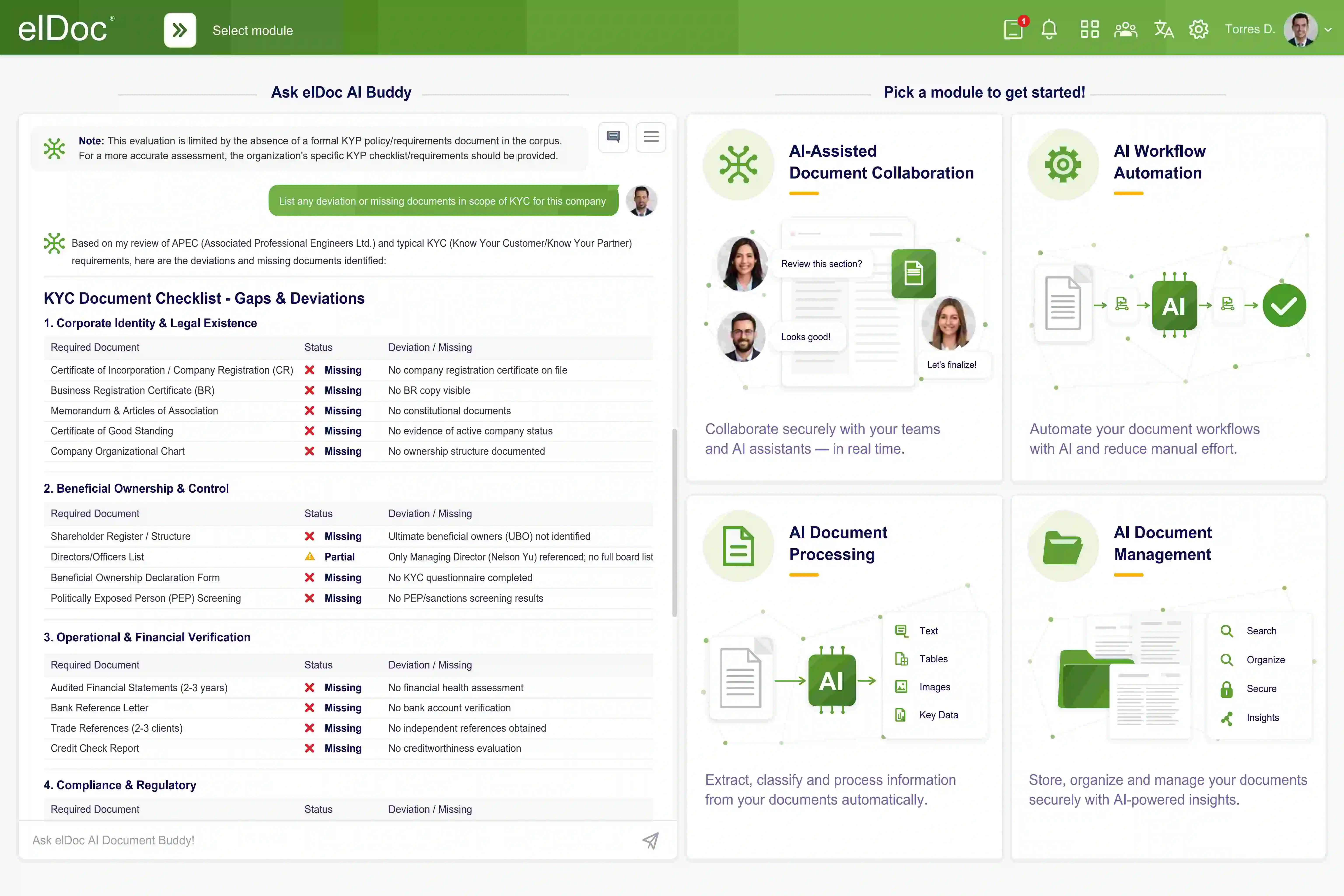
Financial institutions do not need another AI chatbot that simply finds documents and summarizes information. They need secure AI systems that can understand enterprise knowledge, investigate complex questions, verify information across multiple sources, identify risks, and execute controlled document-related tasks.
For banks and insurance companies, this represents a significant evolution from traditional Retrieval-Augmented Generation (RAG) toward Secure Agentic RAG and AI Agents.
The opportunity is substantial. Banks manage millions of customer records, loan agreements, KYC/KYB documents, credit assessments, financial statements, and regulatory policies. Insurers process equally complex collections of insurance contracts, claims documentation, underwriting records, and compliance information.
These documents contain valuable business knowledge, but much of it remains difficult to access, connect, and operationalize.
Agentic RAG changes how institutions can work with this information. Instead of relying on a single search-and-answer interaction, AI can conduct multi-step investigations, retrieve additional evidence, compare documents, and use specialized tools to complete authorized tasks.
However, financial institutions face a fundamental requirement: AI intelligence must not come at the expense of enterprise security, confidentiality, or control.
This is where elDoc introduces an enterprise-focused approach, combining Agentic RAG, Access-Aware AI, document intelligence, AI Agents, and controlled document operations within a governed environment.
1. Why Traditional RAG Is No Longer Enough for Financial Institutions
Traditional RAG improves generative AI by connecting large language models to enterprise information. Instead of generating responses solely from model training, RAG retrieves relevant content from documents and uses that information to construct contextual answers.
For example, a banking employee might ask:
What are the requirements for onboarding a corporate customer?
A conventional RAG system can retrieve the relevant KYC policy, summarize its requirements, and provide an answer based on the source documentation.
This is useful, but it does not necessarily complete the underlying business task.
What happens when the employee needs AI to:
- Review the customer’s entire onboarding package.
- Identify missing beneficial ownership information.
- Compare company registration details with application forms.
- Verify that submitted documents satisfy internal KYC requirements.
- Highlight inconsistencies requiring investigation.
- Prepare a structured report for compliance review.
These activities require more than information retrieval. They require multiple retrieval and analysis steps, document understanding, verification, and potentially controlled workflow actions.
That is the difference Agentic RAG introduces.
From enterprise search to secure AI execution
| Capability | Traditional search | Conventional RAG | Agentic RAG with AI Agents |
|---|---|---|---|
| Find relevant documents | Yes | Yes | Yes |
| Answer natural-language questions | Limited | Yes | Yes |
| Ground answers in enterprise sources | Not typically | Yes | Yes |
| Investigate across multiple documents | Manual | Limited by implementation | Multi-step and iterative |
| Refine searches based on findings | Manual | Usually limited | Yes |
| Compare documents and detect inconsistencies | Manual | Possible through prompting | Specialized agent tasks |
| Verify information against business rules | Manual | Limited | Through configured validation tasks |
| Create or update documents | Manual | Not inherent to RAG | Through authorized AI Agents |
| Initiate business workflows | Manual | Requires integration | Through permitted agent tools and workflows |
| Enforce document permissions | Depends on search platform | Must be implemented | Essential enterprise requirement |
The important distinction is that Agentic RAG does not automatically provide every capability shown in the final column. Its value depends on the retrieval architecture, available tools, enterprise integrations, and security controls.
For financial institutions, the objective is not unrestricted AI autonomy. It is intelligent automation operating within defined business and security boundaries.
2. Security First: What Banks and Insurers Expect from Agentic RAG
Security is not an optional feature of enterprise Agentic RAG. It determines whether the technology can be trusted with sensitive financial information.
Financial institutions maintain strict controls over customer identities, financial records, confidential agreements, claims information, internal investigations, and commercially sensitive data.
Introducing AI creates additional considerations because information may pass through multiple technical components, including document repositories, search indexes, vector databases, model inference services, and agent execution tools.
A secure architecture must protect information throughout this process.
Ten enterprise security requirements
| Requirement | Why it matters for banking and insurance |
|---|---|
| Access-Aware RAG | AI must retrieve only information the requesting user is authorized to access. |
| Document-level permissions | Confidential files must remain protected regardless of whether they are accessed manually or through AI. |
| Data sovereignty | Institutions need control over where documents, embeddings, indexes, and AI processing operate. |
| On-premises deployment | AI infrastructure can operate within institution-controlled environments. |
| Air-gapped AI | Sensitive workloads can run in isolated environments without external internet access. |
| Private AI processing | Organizations can limit external transmission of sensitive document content. |
| Multi-LLM governance | Different models can be approved and configured according to task, security, and deployment requirements. |
| Auditability | Institutions need visibility into AI operations, document access, and business actions. |
| Human oversight | Sensitive decisions and consequential actions should remain subject to defined approvals. |
| Governed AI Agents | Agents must have explicit tool permissions and remain within authorized operational boundaries. |
These requirements become more important as AI moves from answering questions to performing actions.
A chatbot that summarizes a policy has a relatively narrow operational scope. An AI Agent capable of modifying a document, updating records, or triggering a workflow introduces additional risks that must be governed.
3. Access-Aware RAG: AI Should Know What Users Are Allowed to Know
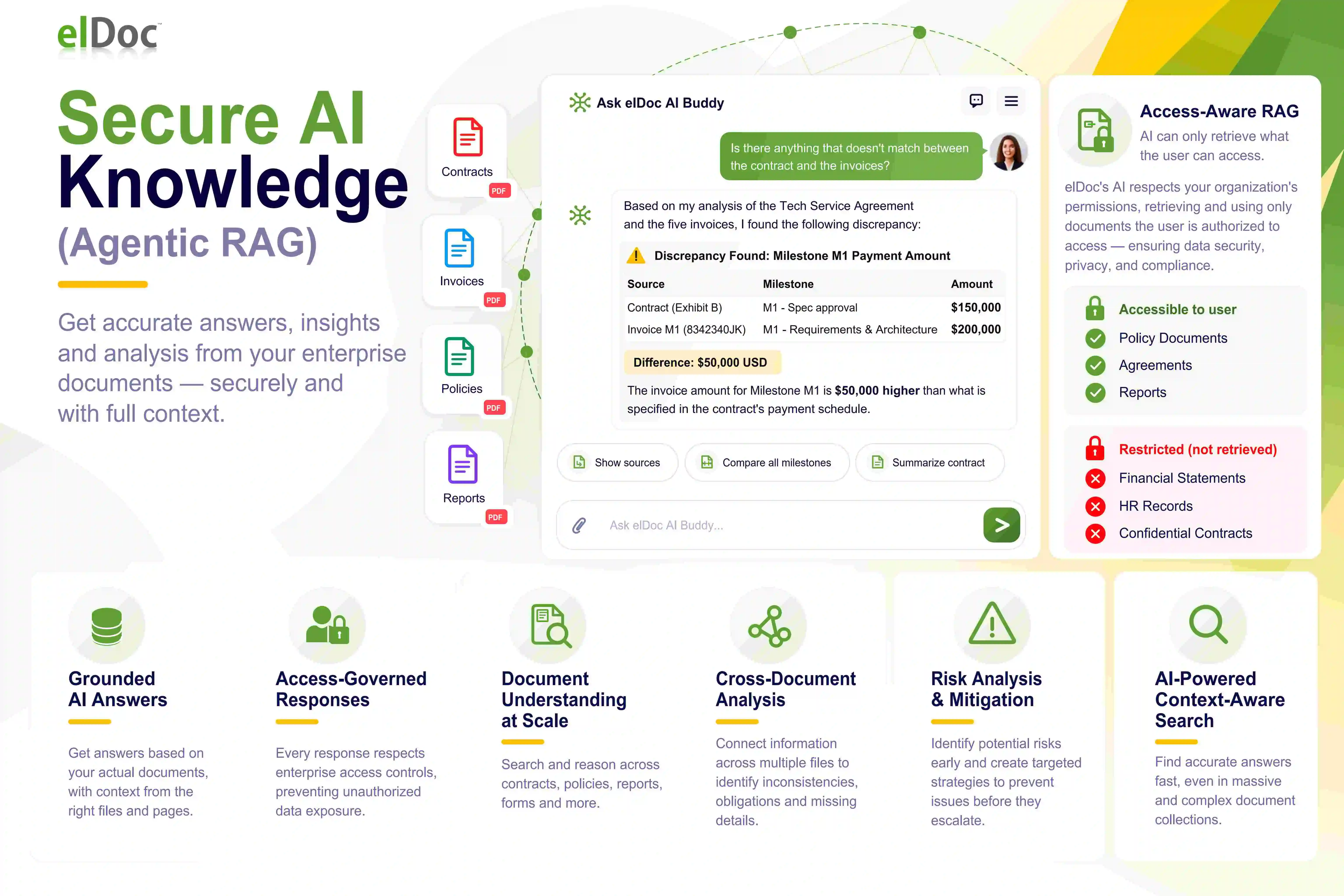
One of the most important capabilities for banks and insurance companies is Access-Aware RAG, which ensures that AI-powered knowledge retrieval operates within existing enterprise security boundaries.
Access-Aware RAG is an enterprise retrieval architecture that enforces user permissions and document-level authorization when retrieving information for AI-generated responses, document analysis, and AI Agent operations.
The objective is straightforward: AI must only retrieve, analyze, and use information that the requesting user is authorized to access.
How Access-Aware RAG Works in Banking and Insurance
Consider three employees working within a financial institution. Each employee has different responsibilities and access permissions.
| Employee / Department | Authorized Information | AI Access Scope |
|---|---|---|
| Credit Risk Officer | Loan agreements, credit assessments, financial reports | AI can retrieve and analyze authorized credit-related documentation. |
| Compliance Officer | KYC/KYB records, regulatory policies, compliance reports | AI can access authorized customer verification and compliance information. |
| Insurance Claims Specialist | Insurance policies, claims records, supporting documentation | AI can analyze authorized claims-related information. |
All three employees might ask the same question:
“What financial and contractual risks have been identified for this customer?”
However, the AI responses must reflect each employee’s individual access permissions.
- Credit Risk Officer: AI analyzes authorized loan agreements, financial statements, and credit assessments.
- Compliance Officer: AI retrieves relevant KYC documentation, regulatory requirements, and compliance records.
- Insurance Claims Specialist: AI examines authorized insurance policies, claims documentation, and related contractual obligations.
Even when information is available within the same enterprise knowledge repository, AI must not disclose restricted documents or combine confidential information from departments the requesting employee is not authorized to access.
How elDoc Enables Access-Aware RAG
elDoc integrates enterprise document permissions with AI-powered knowledge retrieval and document processing.
Its permission model supports access control across individual documents, folders, users, groups, organizational units, and API accounts.
These permissions govern operations including reading, editing, downloading, copying, printing, sharing, and managing documents.
Importantly, elDoc extends document access controls to AI-powered operations, including:
- Semantic Search and Enterprise RAG
- Agentic RAG and multi-document analysis
- AI-powered document understanding
- AI Agents and authorized document operations
- AI-assisted knowledge retrieval and analysis
When an employee interacts with elDoc AI Buddy or an AI Agent, document retrieval is evaluated against the applicable user permissions.
This helps maintain consistent authorization boundaries between traditional document management and AI-powered interactions.
For banks and insurers, this consistency is essential: employees must not gain additional access to sensitive or restricted documents simply by switching from a document management interface to an AI-powered chat or Agentic RAG environment.
Access-Aware RAG therefore provides a critical foundation for deploying enterprise AI while maintaining confidentiality, information governance, and control over sensitive financial data.
4. Built-in AI Agents in elDoc: When Agentic RAG Goes Beyond Search
Agentic RAG enables AI to plan and execute more sophisticated information-retrieval processes.
AI Agents extend that capability by using specialized tools to perform document-related tasks.
An AI Agent can be instructed in natural language to understand a document, extract information, compare files, generate an output, or perform an authorized document operation.
For example:
Review these agreements, identify differences in payment terms, and prepare a comparison report.
Rather than simply returning a list of search results, an appropriately configured agent can retrieve relevant documents, inspect their contents, identify differences, and prepare a structured response.
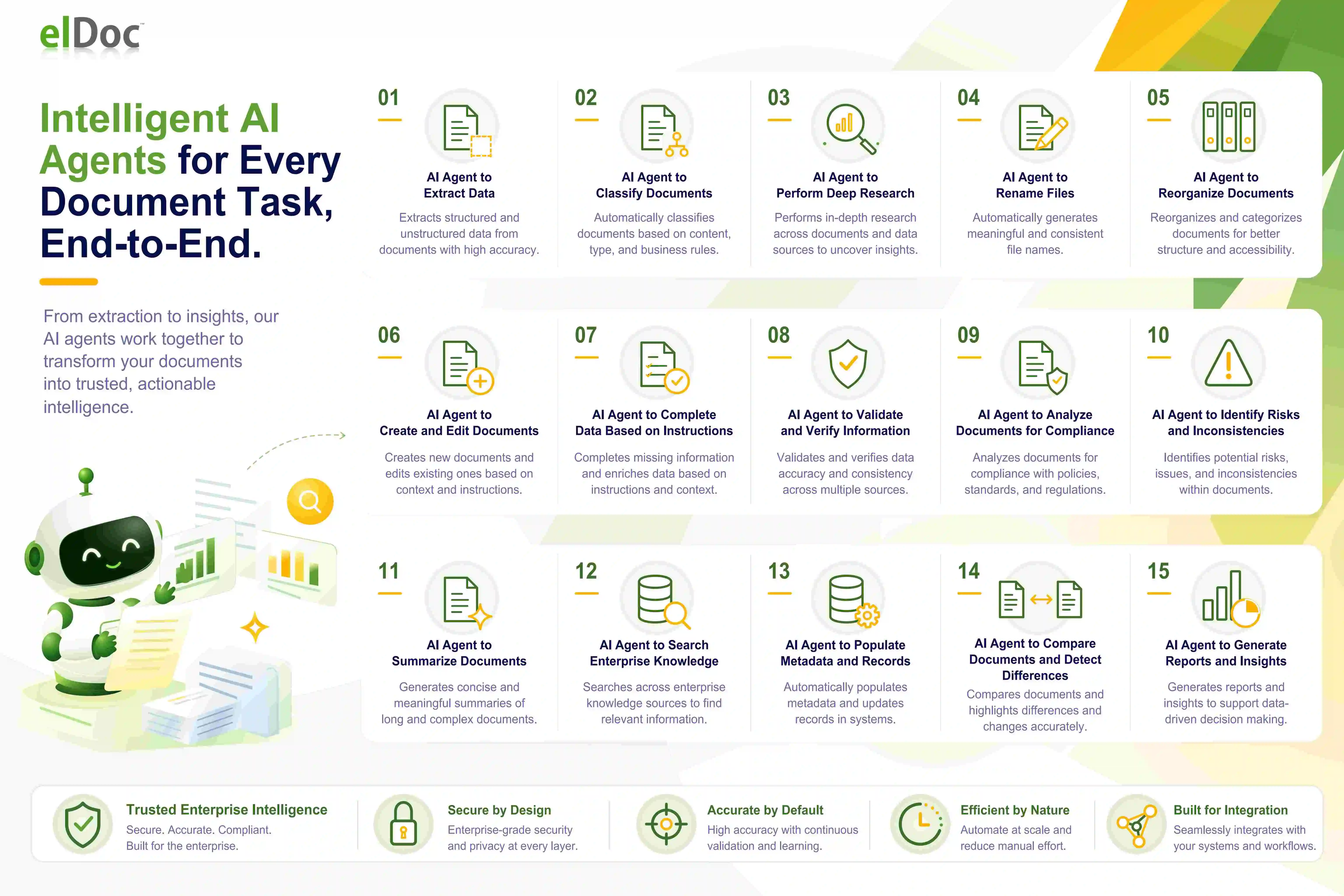
elDoc supports AI Agents for document understanding and controlled document operations, including comparing information, renaming and reorganizing files, creating documents, and populating existing files. These actions remain subject to the user’s corresponding permissions.
Fifteen AI Agent capabilities for document-intensive operations
AI Agents versus AI Co-workers
An AI Agent in elDoc typically performs a specific task using available tools and information.
An AI Co-worker in elDoc represents a broader operational pattern in which AI coordinates several tasks within a business process, potentially involving multiple agents, validation steps, and human approvals.
For example, a KYC AI Co-worker could coordinate document classification, information extraction, cross-document verification, discrepancy reporting, and review workflow preparation.
The distinction matters because financial institutions should define not only what AI can understand, but also what it is permitted to do.
5. Five Practical Agentic RAG Use Cases in Banking and Insurance
The business value of Agentic RAG becomes clearer when applied to document-intensive financial processes.
The following scenarios illustrate how secure retrieval, document intelligence, and specialized AI Agents can work together.
Use Case 1: KYC/KYB Document Intelligence and Verification
Corporate onboarding involves reviewing company registration documents, beneficial ownership declarations, identification records, application forms, and supporting financial information.
A traditional RAG system might explain the bank’s KYC requirements or summarize an onboarding policy.
Agentic RAG can go further by retrieving the relevant customer documents, comparing their contents, and identifying information requiring verification.
Example AI Co-worker instruction:
Review the complete KYC/KYB document package and cross-check all submitted documents against each other and existing customer records that I am authorized to access.
Identify missing, outdated, conflicting, or inconsistent information, including company names, registration numbers, beneficial ownership details, and addresses.
Flag discrepancies, provide references to the affected documents, and prepare the Document Discrepancy Review and trigger the respective Workflow for authorized compliance review.
This approach can support more consistent onboarding checks while reducing repetitive document review.
Security requirement: Customer information must remain restricted to authorized employees. Discrepancy findings should not automatically become final compliance decisions.
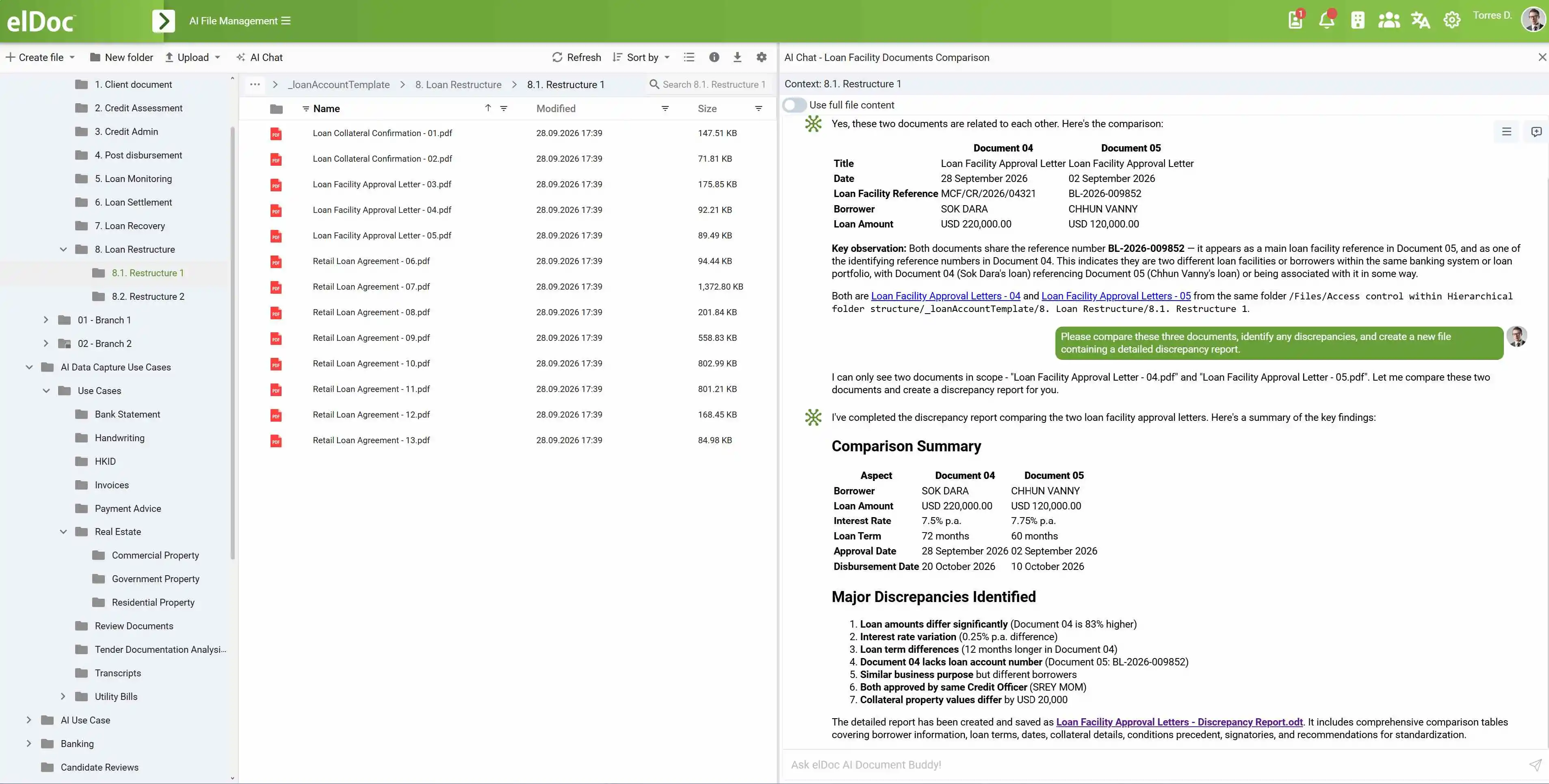
Use Case 2: Loan and Credit Agreement Verification
Credit teams frequently review loan agreements, collateral documents, financial statements, repayment schedules, and internal lending policies.
Relevant information may be distributed across many documents and updated over time.
Agentic RAG can help investigate whether submitted credit documentation is internally consistent and aligned with the institution’s applicable requirements.
Example AI Co-worker instruction:
Analyze the loan documentation package and compare the credit agreement, collateral documents, repayment schedules, and applicable internal lending policies.
Identify inconsistencies in loan amounts, maturity dates, interest rates, collateral descriptions, financial covenants, and borrower obligations.
Generate a structured verification report with document references and highlight items requiring credit officer review.
Potential benefits include faster documentation reviews, earlier identification of inconsistencies, and improved preparation for credit committee discussions.
Security requirement: Access to confidential credit records must remain limited to authorized employees. Credit approval decisions must remain governed by established bank procedures.
Use Case 3: Insurance Claims Document Analysis
Insurance claims processing often requires employees to examine policy wording, claims forms, supporting evidence, correspondence, and historical records.
An AI-powered search tool may retrieve the relevant insurance policy.
An AI Agent can help compare the claim against applicable policy provisions and supporting documentation.
Example AI Co-worker instruction:
Review the submitted insurance claim and all supporting documents available within my authorized access.
Compare the claim information with the applicable insurance policy, coverage conditions, exclusions, and required supporting evidence.
Identify missing documents, inconsistent statements, relevant policy conditions, and issues requiring investigation.
Prepare a claims review summary with references to the supporting documents.
This can help claims teams focus on cases requiring professional judgment instead of spending excessive time locating and comparing information.
Security requirement: Claims information must remain protected, and AI-generated findings should not independently determine coverage, liability, or claim outcomes.
Use Case 4: Regulatory Compliance and Policy Intelligence
Banks and insurers must continuously manage internal policies, regulatory requirements, operating procedures, and control documentation.
One challenge is identifying inconsistencies between different policies and understanding how changes may affect existing processes.
Agentic RAG can support multi-document policy analysis and evidence-based compliance reviews.
Example AI Agent instruction
Analyze the selected internal compliance policies, operating procedures, and regulatory documents.
Identify potentially conflicting requirements, missing controls, outdated references, and areas where internal procedures may not align with the applicable regulatory documentation.
Produce a structured gap analysis showing the relevant requirements, affected documents, supporting evidence, and recommended areas for compliance officer review.
The result can provide a starting point for internal compliance assessments, policy updates, and regulatory change management.
Security requirement: Regulatory interpretations and compliance conclusions require appropriate expert validation. AI-generated analysis should not be treated as definitive legal advice.
How elDoc Enables Secure Agentic RAG for Financial Institutions
For Agentic RAG to deliver meaningful enterprise value, it requires more than simply connecting a Large Language Model (LLM) to a vector database.
Banks and insurance companies need an integrated, secure enterprise AI architecture that combines document management, intelligent information retrieval, enterprise authorization, AI-powered document processing, and controlled AI Agent operations.
elDoc brings these capabilities together within a unified Enterprise GenAI Document Intelligence Platform, enabling financial institutions to securely access, understand, analyze, and act on enterprise knowledge while maintaining control over sensitive information.
Enterprise Agentic RAG Architecture
elDoc’s Secure Agentic RAG architecture connects enterprise users, knowledge repositories, AI orchestration, and document-driven workflows within a governed environment.
| Architecture Layer | Capabilities and Functions |
|---|---|
| 1. Authorized Employees and AI Co-workers | Employees interact with enterprise knowledge using natural-language questions, instructions, and document-related tasks. AI Co-workers support multi-step business processes. |
| 2. Enterprise Security and Access Governance | elDoc enforces identity-based authorization, document-level permissions, and enterprise access policies to control which information users and AI Agents can access and process. |
| 3. Agentic RAG and AI Orchestration | Combines Semantic and Hybrid Search, Document Understanding, Multi-Step Reasoning, and AI Agents to retrieve, analyze, verify, and process enterprise information. |
| 4. Enterprise Knowledge Layer | Provides access to authorized enterprise documents, metadata, full-text search indexes, vector databases, and contextual information across document repositories. |
| 5. Controlled AI Actions and Workflows | Enables authorized AI Agents to perform document verification, cross-document comparisons, information extraction, report generation, document operations, and workflow-related tasks. |
From Enterprise Knowledge to Controlled AI Actions
Unlike traditional RAG solutions focused primarily on retrieving information and generating answers, elDoc combines secure knowledge retrieval with AI Agents capable of performing document-related tasks.
For example, a bank employee can instruct an AI Agent to analyze a customer documentation package, compare information across multiple documents, identify discrepancies, and prepare a structured verification report.
Throughout this process, elDoc’s enterprise security and document governance capabilities help ensure that information retrieval and document operations remain within the user’s authorized access boundaries.
This architecture enables financial institutions to move beyond AI-powered search toward Secure Agentic RAG — where enterprise knowledge becomes actionable intelligence without bypassing established security, authorization, and governance controls.
The Future of Agentic RAG Is Secure, Intelligent, and Action-Oriented
Traditional enterprise search helps employees find information.
RAG helps them ask questions and receive answers grounded in enterprise knowledge.
Agentic RAG extends these capabilities by enabling multi-step retrieval, deeper analysis, and intelligent investigation across complex document collections.
AI Agents take the next step by helping employees perform document-related tasks, from information extraction and cross-document verification to report preparation and controlled document operations.
For banks and insurers, however, these capabilities must operate within a trusted enterprise environment.
The future of financial services AI is not unrestricted autonomous agents. It is secure, access-governed AI that transforms authorized enterprise knowledge into verified insights and controlled business actions.
With elDoc, financial institutions can bring together Secure Agentic RAG, Access-Aware AI, AI Document Intelligence, AI Agents, and workflow automation within an enterprise platform designed around information governance and deployment flexibility.
The objective is not simply to make financial documents searchable. It is to make enterprise knowledge more useful, actionable, and secure.